Tuesday, 28 January 2014

Getting on with it

Strange green plant with zigzag leaves
National Botanic Garden of Wales, May 2013
I left you at the end of induction, and I have now been in the Diabetes department for a few days. I wasn't expected to start clinics straight away, although I did see a patient on day 2, which was fine. I really need to get the hang of what patient information I can give out, and find out where things are in the building and in the hospital. There is a meeting scheduled with the three other Diabetes Dietitians in the Trust, who are based at the other hospital and in the community, and I am hoping to get a better picture from them of how the service operates.

The hospital where I am working is pretty small. It doesn't have an Emergency Department, maternity, or paediatric intensive care, for example. There is a walk-in centre for 'urgent' cases, but anything needing proper hospitalisation will go to the big hospital where I used to work, so it is unlikely that I will see many newly diagnosed diabetic patients. I have met the two Dietitians who cover the five wards in the hospital, and my manager has suggested that I may need to help out on the wards from time to time. I have made it clear to all involved that while I would be very happy to chip in when times are tough, ward work is something I would very much like to keep to a minimum.

The hospital was first opened at the end of the 19th century, although obviously it has been modified since then. The Diabetes department is in a separate building on the site and was built within the last ten years, so it is pretty modern. I have a whole big room to myself, with adjustable heating and a window! I am quite excited about the things I can do now that I have somewhere to store resources in the same room as seeing patients, although I am not the only one to use the room so I can't make it exclusively my own. The main thing it lacks is a table so that I can draw and write easily during consultations - at the moment the desk faces the window and we can't sit around it.

There are just two Diabetes Specialist Nurses (DSNs) based there, along with a clinical Support Worker and some admin staff. Doctors come and go, and there is a big meeting room where we all have lunch and where courses are held. It is so light and airy compared to the cupboard off the hospital corridor where I spent the past year. The Dietitians I am replacing are long gone, and the room had accumulated a whole lot of stuff, so I have started to sort through the legacy and dispose of old and irrelevant material, keeping some things that look like they might be useful.

Lastly, commuting to and from work takes 30 minutes, but the sort of 30 minutes that is almost a pleasure to drive. It avoids all the bottlenecks, is mostly through countryside with farms and animals, A and B roads but no motorways, and once I've left Leamington there is only one set of traffic lights. I'm almost looking forward to the journey!

Friday, 24 January 2014

Induction number 3

Columns of a monument in the distance with pink tulips in the foreground
Cardiff, May 2013
I've been enduring a third episode of workplace induction, to celebrate the start of my third year as an employed Dietitian. It has been uninspiring and tedious, but has also highlighted some important differences between the two Trusts that have employed me.

I'm back at NHS Trust #1, and induction has changed considerably in the two years since I last went through it here. It is much better - I did not have to sit through the wholly irrelevant and inappropriate session about how to order and collect blood for transfusion, for example. We had a practical handwashing session including UV lighting to highlight deficits in technique. There is a whole lot of e-learning to support topics like manual handling, infection control and 'Health and Safety Awareness' where previously these were all live presentations.

In terms of IT, I got my Smart card and ID card within the first two days; my email account and network access were working almost immediately, and as an added bonus my email address is the same as it was a year ago. During induction, the emails I failed to delete before leaving were still there, as were 470 emails received in the 12 months since I last used the account. I even received my own email thanking me for my leaving presents. Unfortunately, on Thursday when I tried to log in, the system told me my account had been disabled, and when IT support got it back, all my emails and files had disappeared, together with all the messages I had been sent that week about where and how to retrieve various documents and details of meetings.

We still had to sit through quite a lot of Powerpoint, though. Welcome from the Executive Managers, the fire officer's lecture stating the bleedin' obvious, Information Governance (which mostly means confidentiality and data protection), an introduction to the Library, a slightly too-graphic presentation about Safeguarding Children, and Conflict Resolution. Oh, how bored I am of hearing about Conflict Resolution. It gets a lot of time in the programme, probably because of national guidelines, but has not changed in two years. Of course we must try to provide respect and dignity to colleagues, patients and the public, and must try to prevent and mitigate conflict, but oh! the endless acronyms and six stages of this or that and don't forget how we are allowed to defend ourselves and use reasonable force to prevent a crime, and what exactly is the definition of Assault, and should it be reported as clinical or non-clinical?

The highlight of the induction two years ago was a presentation on Equality and Diversity, which has now sadly been changed to an e-learning module - the only one in which I scored 100%. I have learned a great deal more about the incidence, prevention and treatment of venous thromboembolism than any Dietitian needs to know. The latest defibrillation machine is pretty snazzy, and it can even tell you whether you are doing your chest compressions correctly.

All in all, having three compulsory days at the very beginning of a new job is a comprehensive, timely and efficient method of ensuring that statutory and mandatory training is done, especially compared with NHS Trust #2. In that Trust, despite my best efforts, I didn't manage to complete my induction and mandatory training in the 11 months I worked there. And the relief of having modern computers with up-to-date software again is only slightly dented by the loss of all those emails and files.

Other good news: parking at the hospital was arranged swiftly and effectively, and I have been given extra hours on a permanent basis, making 27 hours a week over 4 days. Still ten and a half hours short of full time, but much nearer, and I think the end result will be very similar to what I was getting paid in the last job, if you take account of not needing so much fuel or accommodation costs.

Sunday, 19 January 2014

New job tomorrow!

Spherical purple flower
National Botanic Garden of Wales, May 2013
Not much to say of any interest - I haven't been at work, so no new diabetes news; I've been doing quite a lot of reading, so the next book blog will be a bit longer than usual. I've renewed the house insurance, done my income tax return at last (I've never left it this late before, almost time for the next one), and been to London and to Manchester.

In London I saw mum and dad, did some computer maintenance for them, sealed up a leaking kettle, met an old school friend and had a walk in the forest, stayed with Lola II and Mr M, had a tour of BBC Broadcasting Centre (old and new bits), replenished my supply of Japanese ingredients, met another old school friend and watched her do some of her radio show, travelled to Manchester along with mum and Lola II to visit H&B, played with Lola II's music group, replenished my supply of vine leaves and various other goodies at Lola II's local Asian supermarket, and cooked up a feast for Lola II and Mr M. It was a busy week.

Back home I find there isn't much preparation to do for the new job, because the first three days are corporate induction (again) and the next couple will be local induction. It will be predominantly the same as before, so maybe I can report any changes since the last time, two years ago. I have been told that my contract of three permanent days a week is likely to be extended by one further day, but it is likely that I will not be working on Tuesdays. At first I was disappointed, but on reflection this does give me scope for doing all sorts of different things, both work-related and nothing to do with work. I have some ideas, but we'll see what happens.

Monday, 13 January 2014

Ski/bike holiday

View of the village with the mountains beyond
Ellmau, January 2014
I'm guessing that one or two of you are interested in our holiday - it was fun, I gradually remembered how to ski with the help of one lesson on the second day, the weather was horrible on the first day but improved after that, Mr A absolutely loved his snow bike.

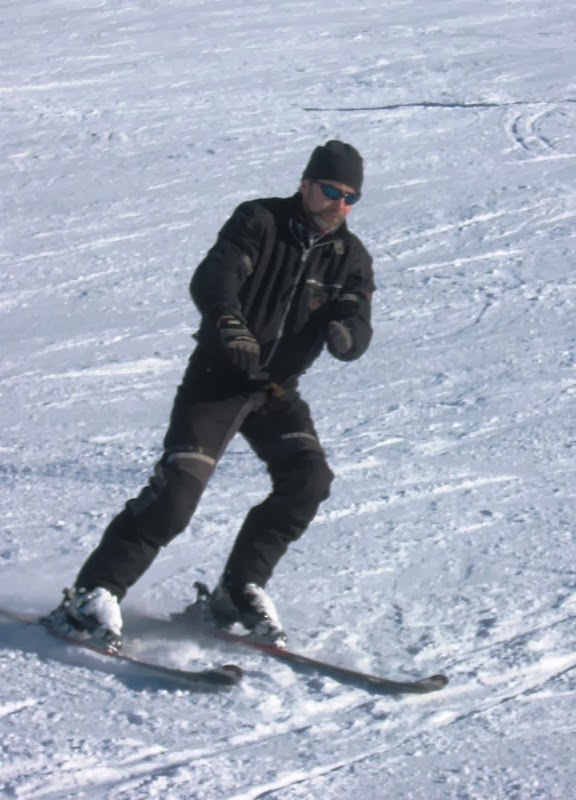
Me, skiing
Ellmau, 2014
We went to Ellmau, in Austria. The resort is sadly lacking in snow, and it appears this is generally the case across Europe at the moment. In the olden days skiing would have been impossible, but thanks to snow generating technology the pistes were fine. Down in the town and anywhere off-piste, there was nothing, which meant a bit of ski removal and walking to the lift stations at the bottom.

This was the seventh ski holiday that Mr A and I have undertaken, and all have been very different.

Macugnaga, 2004
The first was to Macugnaga in Italy, a very small resort, but perfect for first-timers. Mr A hadn't skied before and I hadn't skied since university, so we had some lessons before going out and joined group lessons when we were there. This also meant we made friends with another family and could do a bit of socialising in the evenings. The highlight of this trip was the evening meal at a mountain restaurant, which we reached with our skis on by hanging on to a rope trailing from the back of a skidoo. There were two skidoo drivers; mine went at a terrifying speed and traumatised all his passengers, while the other one was beautifully sedate and its passengers were bemused as we staggered into the restaurant.

Soll, 2005
Next time we went to Söll in Austria, taking The Boy and his girlfriend with us. They had snowboard lessons and we improved further in our ski lessons, although Mr A was already starting to have trouble with his knees. The third trip was very interesting - we went to Ruka in Finland, not noted for its downhill skiing. It certainly had nothing to match the Alps or the Tirol, but we were self-catering with four other friends in a cosy log cabin with a sauna and had a jolly good time.

Ruka, 2006
The fourth trip was to Champoluc in Italy, where the hotel was adjacent to a piste and only yards from the main ski lift station. This was a huge benefit - no need for ski buses or long walks to get started in the morning or to get back to the hotel in the evening. Mr A had invested in some highly expensive personalised ski boots, but it was becoming clear that even these didn't provide sufficient relief, and this was when he had his first go at snowboarding. This holiday was particularly memorable because at the end of the penultimate day, we went for a walk and I fell over and broke my leg.

Champoluc, 2007
Mr A decided to abandon skis and try snowboarding for the next holiday, which was in Meribel, France. I thought I'd try it as well, and blogged about it twice. This was the least successful holiday in terms of snow-based activity, but we were in a chalet with nice people and went to a comedy gig.

Galtür, 2011
Then there was a gap of three years before our next trip, to Galtür in Austria with our friends J+C, which I also blogged about. This one was notable for the food, and because I finally abandoned my attempts to learn to snowboard and returned thankfully to the skis. Mr A also decided that his arthritic knees couldn't cope with the stress of snowboarding either, despite the more comfortable boots.

So, how did Ellmau compare? The hotel was quite a long way from the town up a steep hill, which would have been bad for après ski activity had we been able to stay awake later than 8 p.m. As it was, there was a piste nearby so we didn't have to rely on the infrequent ski buses, and on the few occasions that we walked up the hill, it just felt like an extension to the exercise we were getting anyway through the day. I had a great time on the slopes once I'd remembered how to ski; Mr A had the time of his life as soon as he got on his bike. We had chosen Ellmau purely because of the presence of snowbikes for rental, and now Hans the snowbike man is one of Mr A's best friends.

Apparently, there are two types of snowbikes: both have ski runners instead of wheels, but with one type you stand on pegs in your ordinary boots, and the other type, which is what was available here, you have short skis on your feet and sit down to ride. This meant Mr A still had to wear his incredibly uncomfortable ski boots, but there was hardly any strain on his knees, and for the first time he could actually get some speed up and do some work. The disadvantage to this was that he is still wearing motorbike gear rather than ski gear, and he described it as "spending the day in your own personal sauna." His jacket and trousers now need some serious deodorising, as well as the rucksack he stored them in.

I didn't quite manage to leave work behind, in as much as I occasionally pondered the enormous challenge that such a holiday would be if you had Type 1 Diabetes. You'd have to test loads, have snacks constantly on hand in case of hypoglycaemia, all the food is unfamiliar so estimating carbohydrate would be difficult, and all that exercise would affect your sensitivity to insulin so you might have to reduce the amount you inject by a proportion you can only guess at. And in the evening, you don't actually know what dinner will be. Without an insulin pump you'd either have to give yourself an injection per course as the food arrived (up to four injections), or take a guess at the start, count as you go along and correct at the end (two injections), or wait until the end (one injection but you'd have to endure post-meal high blood glucose).

Anyway, I've still got a week to play with before having to go back to work, and I've spent a whole day on unpleasant tasks like house insurance and self-assessment for income tax. Tomorrow I'm off to spend some family time; we'll see if there's enough time for blogging too.


Friday, 3 January 2014

An interlude

Wooden chair in formal gardens
Groombridge Place, June 2013
Christmas has come and gone, the New Year celebrations passed, and I have left one job behind and am looking forward to a different one. But in the meantime, it has been by turns restful and hectic.

I was working on the Monday and Tuesday before Christmas Day, and Mr A was in charge of preparations. He did a great job, and we had a delicious seafood medley for Christmas dinner, plenty of sitting on the sofa in front of the fire, watching DVDs, reading some books and even watching a couple of TV programmes. I was back at work on the Monday and Tuesday before New Years Day, but those were my last two days there. I had scheduled patients, but most of them didn't turn up. The most reliable were those with Gestational Diabetes, for obvious reasons. A year ago I enjoyed the predictability of the ante-natal clinic, but ended up tyrannised by the inexorable progress of pregnancy.

We had no plans for New Years Eve until the very last minute. I had anticipated quite a long and busy last day at work, but it wasn't like that at all. The Diabetes Specialist Nurses told me that sometimes it can be crazy busy, but for some reason this year there were few referrals, and we even had time to spend a break together in the hospital coffee shop. I cleared my computer, cleared my drawers, cleared my desk, cleared the room and managed to get away mid-afternoon.

Mr A suggested that we try and gatecrash the party at the Pub Next Door, by pulling rank as Very Important Neighbours. Their ticket-only party had been advertised for a while, but I had thought I would be too tired from the working and the driving, so we hadn't signed up. We found, however, that the party wasn't happening after all, and it was to be a fairly normal night at the pub, so there was no need to call in any favours, we could just go next door as normal customers.

Of course, Smurf couldn't let an opportunity pass for some sort of mischief, so he was dressed as Elvis, in a white shiny outfit and big wig that must have been awfully sweaty at the end of the night. He and the other bar staff were downing shots at a rate that made me wonder how they could still stand up by the end of the evening. Towards midnight they turned the music up and Mr A and I were first on the dancefloor, the traditional countdown to New Year took place, there was a bit more opportunity for dancing and then Mr A and I went home. We have managed to avoid the staid married couple story of 'can't be bothered to stay up until midnight' for several years now, in various interesting and enjoyable settings.

My new job starts in a couple of weeks, and I have Plans of all sorts for the intervening time. I started with planning a trip to London and another trip north, but mentioned to Mr A that it would be a perfect opportunity for a snow holiday. He took up the challenge with gusto.

Mr A has now admitted defeat with both the skiing and the snowboarding. His legs, both broken in his mid-20s, were poorly set and his feet and shins cannot be comfortably accommodated in ski or snowboard boots with any success, even in the boots that were ludicrously expensive because they were moulded to the shape of his legs. But always optimistic, he started looking into the possibility of renting a type of ski bike that we had seen on the slopes during our last snow holiday.

With less than a week's notice, we are now booked for a week in Austria. Since I have a day or two at leisure, I spent a couple of hours practising at our 'local' SnowDome, which was a very good idea indeed. I progressed from just about remembering how to snowplough right through to parallel turns in the space of two hours, which has made me a million times more confident, and means I'm looking forward to our holiday a great deal more.

So I will be absent from this blog for a while, but with any luck Lola II may fill the hiatus. She was planning a blog post a while ago, and she has been on holiday as well, so maybe she will surprise us!

Large artwork on hospital corridor
No idea why this is in one of the hospital corridors - the caption is 'Negev'

Tuesday, 24 December 2013

Nearing the end

Art deco frontage topped by statue of a woman holding aloft a large golden ball
The Assembly, Leamington Spa
As a parting gift to my current department, I have thrown together a draft of another new patient information leaflet, this one about Exercise and Type 1 Diabetes, which I will no doubt share on this blog in the fullness of time. I can tell you now, though, of all the difficult things you have to do to stay healthy if you have Type 1 Diabetes, managing activity and exercise is one of the most difficult. I'm not even talking about competitive sports, it might just be walking about for an afternoon.

I was inadequately prepared for Christmas in a multi-disciplinary team, which is what the Diabetes Team turns out to be. There was I, thinking it was a collection of individuals with little in common except a passion for diabetes and incessant complaining, and I was hoping that Christmas would be over soon so that the endless supply of cakes and chocolate would cease. (I have maintained my weight, which I consider to be a significant achievement, by dint of eating nothing at all in the evenings.)

So I was surprised when I was given presents (in order of physical size and weight) by the diabetes consultants, by the Diabetes Unit (which I think comprises the nurses and admin, but I got quite a vague answer when I asked), by my team leader, by RSB, and by my other Diabetes Dietitian colleague. I did not anticipate this, and had prepared no presents at all, although I did have the multiple cakes and vine leaves to contribute to departmental catering. I am the Scrooge of Diabetes, but it can't be helped, it's too late now.

My leaving buffet after work on Thursday was delightful. Colleagues had brought in two slow cookers full of vegetarian lasagne and chilli con carne, and there was rice, bread, tortilla chips and rather a lot of stuffed vine leaves, plus cake. As a leaving present I was given more than I felt I deserved in M&S vouchers, and made a short speech that I don't think was too awful. It all ended at a reasonable time too, and instead of going home to pack like I should have given that I was moving out the next day, I went to badminton instead, and packed up on Friday night.

So now I am no longer a resident of two different towns, and my possessions were spread over a large surface area of the house on Friday because I was too tired to put anything away. On Friday night I was in bed by 9.30 p.m. and didn't get up in the morning until nearly 11 a.m, and on Saturday I managed a trip to do final bits of Christmas shopping but that's about it. Sunday was better, with a good deal of tidying up, wrapping presents and a trip to the supermarket with Mr A for things he considers essential for satisfactory celebration of the winter festival season.

With only four working days spread over two weeks, I am looking forward to finishing, and have a few exciting plans for the nearly three weeks I will have without work. Mr A has been doing all the Christmas-related card-writing, and I have done absolutely none this year. I may possibly manage some emailed greetings, but even that is looking unlikely. I have received actual physical cards from four known readers of this blog, so thank you very much H&B, CERNoise, Landrover Man/Bee Lady and Lola II/Mr M. And season's greetings to everyone else who knows me.

Tuesday, 17 December 2013

What I've been reading

Image of the book cover

The Rendezvous and Other Stories
by Daphne du Maurier
"The stories in this collection, some written before du Maurier published her first novel, reflect many human emotions: romance, disenchantment, fantasy, nostalgia, ambition, irony, the longing for adventure."
They were a varied bunch of stories, none outstandingly good or memorable, but sharply drawn and beautifully atmospheric. I'm sure I used to enjoy short stories, but these didn't really hit the spot.


Image of the book cover

The Love Letter
by Fiona Walker
"When Allegra North parted from first love Francis after a decade together, she poured all her regret into a letter. He didn't reply. A year later, her job brings her back to the beautiful Devon coast where romance first blossomed."
The tenth of my 12 Books of Christmas, and I'm sure nobody will be surprised that I didn't enjoy it. It was, however, much better than most of the others, perhaps even the best yet, but still so far into the territory of Chick Lit that it couldn't be retrieved by the decent standard of the writing. A lot of characters are introduced, all of whom have complicated relationships with each other, and I couldn't be bothered to read back and untangle them all. It went on for ever, the eponymous love letter hardly featured, and I was relieved when it was all over.


Image of the book cover

Good Omens: The Nice and Accurate Prophecies of Agnes Nutter, Witch
by Neil Gaiman and Terry Pratchett

narrated by Stephen Briggs
"The armies of Good and Evil are amassing, the Four Bikers of the apocalypse are revving up, and everything appears to be going according to Divine Plan. Except that a somewhat fussy angel and a fast-living demon are not particularly looking forward to the coming rapture, having thoroughly enjoyed life on earth amongst the mortals."
Another disappointment - the effect of Terry Pratchett in audiobook form seems to have worn off. I found it too difficult to follow what was going on and who all the characters were. There seemed to be less cleverness in the story, or if it was there, I missed it. And it was a pity that the young characters sounded like they had been lifted from Just William, and seemed hopelessly out of date.


Image of the book cover
The Tenant of Wildfell Hall
by Anne Bronte

narrated by Alex Jennings and Jenny Agutter
"Helen Graham has returned to Wildfell Hall in flight from a disastrous marriage. Exiled to the desolate moorland mansion, she adopts an assumed name and earns her living as a painter."
In contrast with my recent choices of reading, this seemed exceptionally good. Despite being set in a period where social life and mores differ significantly from our own, it provided a realistic story with believable people, although I didn't find any of them particularly attractive. Against a background of the best of classic literature, however, I expect it is not quite as exceptional as it seemed on this occasion.


Monday, 9 December 2013

Commissioning diabetes services

Great Horned Owl
Cotswold Falconry Centre, April 2013
At this very moment, right now this instant, I should be getting on with my admin. After a triumph last weekend when I finally, FINALLY managed to switch energy companies, I thought I would keep up the momentum and finish the deal with sorting all the bits of paper heaped up in an enormous pile.

So far this weekend, I have been obliged to go to two, count 'em, TWO Christmas dinners, as well as having my hair cut and going to the greengrocer and making two cakes. Because I am leaving work and there is only one weekend left before my leaving 'party' and I want to stuff vine leaves next weekend and that takes ages. So cakes must be baked this weekend, but I can't do another one because I have run out of cinnamon, so I have to do my admin. Except for the small matter of blogging.

Christmas dinners: one was on Friday night in a local pub/restaurant with my home badminton club that I haven't played with for six months, and the other was on Saturday night in a posh hotel with the Dietitians from the hospital where I used to work a year ago. On balance I probably liked the second one better, because there was a live band and lots of dancing. But the first was very good too.

Cakes: one spiced with fruit, one lemon drizzle.

My leaving 'party': this is taking place after work in a couple of weeks, when a modest buffet will celebrate two people leaving and one going on maternity leave.

Work is a bit strange because I will be leaving in less than a month, so I have much less patience for all the annoying things that happen on a daily basis. Colleagues are constantly complaining about all sorts of things, some of which are genuinely troublesome, but a lot of which are just giving them the pleasurable sensation of feeling put upon. Nothing much has changed in my world, except that I have at last finished the Carbohydrate Reference Tables and sent them for approval by the Trust communications police via the approved route, and have heard nothing at all for two weeks.

The main complaint at the moment concerns a plan by the Clinical Commissioning Group (CCG) to improve the service given to people with stable Type 1 diabetes who are registered with City GPs. The CCG is the official body now authorised to commission services and spend the NHS's money, and it wishes to discharge these patients from care within the city hospitals to be seen in an 'intermediate' service in the community instead. The advantage to the patients is that clinics should be easier to get to and there will be some evening and weekend appointments. There is no change planned for patients who live further afield in the catchment area served by the Trust. People with Type 2 diabetes under the care of the City CCG have already been discharged in this way, but they are back under the care of their GPs rather than being seen in a specialist diabetes service.

In itself, this plan is a good thing. The difficulty lies with the bitter internecine conflict between staff in the Diabetes service based in the two hospitals within the Trust. I may have written long ago about the attempts being made to bring the two locations together somehow, but we have not only remained as two separate units, but the divisions between the two seem to have increased. All this is helped not at all by feuding Consultants and an extreme lack of nurses that is due to become worse when three nurses reduce their hours and one goes on maternity leave in January. Despite the lack of consensus and the lack of staffing, the CCG continues to press forward with the plan.

Some of the difficulty was brought into the open recently because we offer two completely different types of Structured Education, which NICE says should be offered to people diagnosed with diabetes soon after diagnosis. Quite a lot of information, knowledge and skill is needed to manage diabetes in the best possible way, and there are many courses available, some of which are based on a national curriculum and others developed locally. Suitable courses must be evidence-based, and must demonstrate that participants have better outcomes in their diabetes management after they have been on the course.

The two hospitals in the Trust currently offer different Structured Education packages, one developed locally and one licensed nationally. The CCG wishes to offer just one type of Structured Education in the new service, and it is proving difficult and divisive to decide which one this will be. Emotions are running high, as various people have a deep commitment to one or other of the courses, and not only seem unable to decide which to choose, but also seem unable to settle upon a method by which the choice should be made.

The decision to discharge these patients into the intermediate service has also been made seemingly without adequate consideration of the practicalities. How will appointments be made, and by whom? Who exactly will be seeing the patients, and what level of qualifications should they have? Where will they be seeing the patients? What data will need to be recorded, and where and how will it be kept and made available to people who need to see it? How will patients contact the key doctors, nurses and dietitians? A date has been circulated for when the new service will start, without any reassurance that these questions have been considered.

The more forcefully that the new service is pushed, the more resistance is developing, and where I sit and have my lunch all goodwill has evaporated towards the instigators and supporters of the scheme. It is unusual for a day to go by without someone starting up some sort of complaint about the whole situation, and all and sundry chime in, and my pleasant relaxing lunch break is over.

I am very much looking forward to the new job, and it was very useful chatting at the Dietitians' Christmas do. A colleague asked how many days I would be working, and I was able to turn to the manager (who was sitting next to me) and ask, "How many days a week will I be working?" Her answer was "At least four," so that's a bit clearer now. I'm not exactly sure what I will be doing, but another colleague said that she had trained my predecessor for a renal clinic (kidney damage is one of the complications of poorly-controlled diabetes). I was also told that the Diabetes Dietitians in the Trust who are based in a couple of other locations have regular meetings as a team, so I should be able to draw on the expertise of more experienced colleagues for support and for clinical supervision.

Stop Press: my Carbohydrate Reference Tables have been returned by the official people who approve such publications, and who now want us to get written feedback from five service users before approval will be given. And so it goes on...

Saturday, 30 November 2013

Learning, changing jobs and home news

Green plant
National Botanic Garden of Wales, May 2013
It's one of those times when I think I've written all that I can about everything, and there's nothing left to blog about. I have an interesting and fulfilling life, it's true, but there's nothing particularly interesting to write about. Living in two places, work, badminton, family, the house and the blessed car - nothing you need to know. Mr A and I have a new boiler, the brakes on the car have been fixed, I have been on a course, that's it.

OK, so let's try harder.

I handed in my assignment for the module I'm doing for a Masters degree. It was a case study, all about a patient who was newly diagnosed with Type 1 diabetes at a relatively late stage of life, but who also is very overweight and has other health problems too. As usual, I write this on the basis that there's no reason at all to think that the patient isn't reading along with us, which makes it difficult to describe much more about the situation. I learned quite a bit about various aspects of diabetes by reading up on the evidence base, but it seemed to take an enormous amount of time. I'm not sure that doing more modules towards a Masters is how I would like to carry on with further professional development.

I have had my exit interview with my current employer - I think the administrator whose job it is to arrange these things was a bit enthusiastic, seeing as it's more than a month until I finish. It's also ironic that I haven't yet been able to complete the mandatory training associated with my induction. Anyway, I fed that back, which gave us something to talk about, along with the difficulties of having a fixed term contract working in a Diabetes department that often feels like it's in a continuous crisis situation. I would have no hesitation working with any of the Dietitians in the hospital - not just the Diabetes Dietitians - but I'm not sure I'd want to work in this Diabetes department again.

Luckily, I was allowed to continue with the training I'd been booked to do before I handed in my resignation, which took place last week. It focused on behaviour change (level 1), and covered much of the same ground as the Communication Skills module I did while at university. If done well, it can transform a difficult interview, and can help patients to achieve the results they are after. At the moment, I can see the potential and know in principle what I should be doing, but achieving it is another matter. It is something that I plan to practise as much as possible.

The new boiler was installed in my weekend home without fuss, according to Mr A who was there at the time. I played in a badminton match for the 1st ladies team of my weekday home, which is well above my standard, so losing 6-3 was a good result. I failed to get my hair cut through lack of booking ahead, mostly because I couldn't remember the name of the hairdresser. I'm busy making extravagant plans for the nearly three weeks I will have between the old and the new jobs, but will probably just sit around, as usual.

Sunday, 17 November 2013

Gestational Diabetes

Statue of a bear looking over a ridged wall
Cardiff castle, May 2013
I started writing this post some considerable time ago, which is a little ironic. Not many posts have needed incubation.

Every week, I see a few patients who have just been diagnosed with Gestational Diabetes Mellitus (GDM). And when I say 'just diagnosed', sometimes it's been in the last hour or two. Some have had it before, some take it in their stride, and some are completely freaked out.

For each of these women, I aim to give them basic dietary information in 30 minutes, and then they can have lots more input the following week if they need it when they come back for a scan and a full check-up. When I started writing this post, the shortest time I had managed was about 40 minutes, and when I first started in the job it was more like an hour. Now I've got it down to a well-practised routine.

The diagnosis is made by screening women who have one of several risk factors, including pre-pregnancy BMI over 30 kg/m2, a previous baby that weighed 4.5 kg or more, previous gestational diabetes, a first degree relative who has diabetes, or one of several ethnic backgrounds that have a high prevalence of diabetes. Screening is usually done at around 26 weeks into the pregnancy. The fasting blood glucose is measured, then they are given a measured dose of glucose to drink, and after two hours their blood glucose is measured again. In our Trust, if the fasting level is greater than 5.4 mmol/L or the 2-hour level is greater than 7.7 mmol/L, then bingo - the diagnosis is Gestational Diabetes. Even if the fasting level is 5.5 or the 2-hour level is 7.8 mmol/L.

For most of the time when I see people in the general diabetes clinics, I have to respond to what the individual brings to the consultation. It could be anyone, with any type of problem, or no problem at all. For this ante-natal clinic, it's always a woman, it's always gestational diabetes, and the advice is always the same at this initial stage. So it's an opportunity for me to hone things over the weeks, to get the right messages delivered as well as I can do it.

My first inclination was to do a bit of research, to make sure that my advice is based on the best available evidence. Two documents were the obvious starting point: the NICE guidelines, and a Diabetes UK document, both from 2008. I also found a couple of academic papers.

There are two main reasons that diabetes in pregnancy needs to be addressed. High maternal blood glucose means that the baby will receive more glucose than necessary via the placenta, and will secrete higher levels of insulin to compensate. Any energy that isn't needed for growth will be laid down as fat, generally around the middle and the shoulders. This can complicate delivery, with a higher risk of the baby getting stuck (shoulder dystocia) and trauma to the mother. The other issue is that after the baby is born, its blood glucose will drop to normal levels, but it may still be producing a lot of insulin. Hence there is a risk of post-natal hypoglycaemia, to the extent that the baby might need a glucose drip for a day or two until it sorts itself out.

After delivery of their baby, mothers are offered a six-week follow up glucose tolerance test, and the good news is that for most mothers the diabetes will have gone away. According to the US National Diabetes Education Program, however, 5 to 10% are found to have diabetes at this point, usually Type 2. Those who don't have diabetes at this stage still have a seven times higher risk of developing Type 2 later in life than if they hadn't had GDM.

I work with a specialist midwife in the clinic, and we take it in turns to deliver our messages. She covers the clinical information, and provides a meter so that the mother can test her blood glucose seven times a day: before each meal, one hour after meals and once before bedtime. Seven times a day, every day until the end of the pregnancy. Some women have had to do this before, some women take it in their stride, some women... well, you can imagine.

So what is my dietary input? In 30 minutes, I cover the following:
  • An explanation of Gestational Diabetes, and how food affects blood glucose.
  • Reassurance that they haven't developed GDM through eating too much sugar or too many pies.
  • The treatments available (diet, tablets, insulin, in that order) and that if you progress to tablets and insulin it's not necessarily because you're doing anything wrong, but this is a progressive condition.
  • What is their 'normal' or 'typical' diet? [I love a good diet history, you find out such interesting things]
  • Foods that don't significantly affect blood glucose (protein, fat, vegetables/salad, diet drinks, sweeteners, vinegar, herbs, spices) and those that do (sugary and starchy carbohydrates, including fruit, milk and yogurt).
  • The difference between sugary and starchy carbohydrate in terms of their effect on blood glucose, and the difference between a lot and a little carbohydrate.
  • What a reasonable portion size of carbohydrate should be.
  • Check that they are aware of advice on food safety and hygiene, avoiding liver, pate, uncooked shellfish and eggs, blue, soft and unpasteurised cheese, limiting intake of certain fish (swordfish, marlin, tuna), and the suggested restriction on caffeine.
  • The benefit of activity on general health and particularly blood glucose control.
  • And... any questions, at which point I have an eye on the clock and hope that they are completely overwhelmed with the information so far and will keep their questions for another day.
One of the reasons for clock-watching so closely is that the only time the midwives can run this clinic is on a Friday afternoon, when up to four women are scheduled. Run over a few minutes on each, and we're not going home on time. I can fill an A4 sheet with drawings, graphs and lists of food in clear handwriting faster than you can imagine.

The evidence behind the dietary advice for GDM principally supports a focus on a healthy balanced diet containing low glycaemic index carbohydrate food that is digested quite slowly. I often use the analogy of a sink with a blocked drain, where the level of water in the sink is the blood glucose level. Turn the tap on full blast and the sink overflows; put in the same amount of water (carbs) at a slow trickle and the level will only rise a little. It is all meant to limit the period of time when blood glucose is above the optimum level.

Women often ask how much carbohydrate is enough, or whether cereal A or B is better. I can give a generic answer based on population studies and determination of glycaemic index and glycaemic load (which is the index multiplied by the amount of food). The easiest way to address this question, however, is to point out that they will be testing their blood glucose before and after meals, and after just a few days they will know what 'too much' looks like. 

My dietetic advice differs slightly from the usual 'healthy eating' messages, because short-term glycaemic control is much more important than long-term cholesterol levels, for example. So a high protein, low carb cooked breakfast isn't such a bad thing for the few final weeks of pregnancy, because eggs, bacon, sausage, mushrooms, tomatoes and baked beans hardly contain any carbs at all. Crisps are a comparatively good choice of snack compared with sweets, cake or chocolate, but nuts are even better (as long as there is no history of nut allergy in the family). Reduced fat houmous with vegetables is probably the best choice for a snack that I can think of - low in fat, high in fibre with minimal effect on blood glucose.

Follow up in clinic consists of reviewing the blood glucose numbers recorded, and seeing a) if there are any above the target levels and b) whether these are occasional and random or frequent and showing a pattern. The woman may want advice on better choices for a particular meal, or she may have been experimenting to find the best type and amount of cereal for breakfast. There has been only one woman I can remember who seemed to deliberately ignore dietary advice and who changed nothing. Most are prepared to put up with everything because it's usually for only three months, and it's clearly worth it for an easy delivery and a healthy baby.

Related Posts Plugin for WordPress, Blogger...