Showing posts with label diabetes. Show all posts

Wednesday, 2 June 2021

The beginning of the end

Two bunches of flowers, an orchid and a box of posh chocolates
June 2021
Student Lola Life ended in 2012 with the End of the Beginning, as I transitioned from a student to a qualified Dietitian with a real job. Dietitian Lola Life started on the same day, and is now ending with the last day of my job as a Dietitian. 

In my diabetes workplace we had a celebratory lunch last week, and this evening I met my Dietitian colleagues for a pint and a pizza. We ordered our pizzas in the pub, only to be told that due to unforeseen circumstances there weren't any pizzas, but we could order our own for delivery. Having tried unsuccessfully to do that (no deliveries at the moment) we decamped to order in person and sit in an actual working restaurant - third time lucky. It was a lovely evening.

I'm not retiring as there is plenty for me still to do, paid and unpaid, but a new look for the blog is called for to mark this momentous event, not least in order to introduce a slightly larger font size. I hope you'll stick around - my new home is Lolatastic!

Sunday, 21 March 2021

Vaccinating is exhausting

Three of the four vaccination stations in the Portakabin clinic
Coronavirus Vaccination Clinic 2 (the Portakabin), March 2021
You've had to wait for it, but the answer to the puzzle of what's in the bag hanging from my clothes airer relates to the fact that due to overconsumption and lack of willpower I had to go cold turkey on chocolate and snacks. I still had quite a large supply in the house and didn't want to throw them out, which meant that they had to be more inaccessible. Hence, hanging them up out of reach and out of sight. It worked quite well.

I've done a lot of reading in the last month as evidenced by the huge blog post last week, but there's also been a lot of other activity. The physiotherapist is suggesting that the longstanding issue with my hip is probably the source of the problem with my knee, and has changed my exercises. I am finding it increasingly difficult to motivate myself to actually do the exercises. And I have attended a very interesting Zoom webinar about the Libre 'Flash Glucose Monitoring' technology in diabetes, and I wonder if my colleagues already know about the things I learned.

I have been on annual leave from that job and signed up to many vaccination shifts, some of which were cancelled. We are doing far more work compared with that first session when I was shown the ropes - enthusiastic people are coming for their second dose as well as a few unenthusiastically turning up for their first.

We are now using iPads instead of paper forms to track our vaccinations, which I'm sure saves an enormous amount of data input, but relies heavily on our systems finding the individual. This means that the NHS number is quite important, name and date of birth being surprisingly unreliable. Obviously nobody knows their NHS number, but there is a website where it can be found, and so notices were put up asking people to type the long URL on their phones. This is quite difficult, so I suggested to the people doing the clerking that they could generate a QR code, at which they looked very blank.

I've only just started to appreciate the power of the QR code, which is the two-dimensional bar code that can be scanned by a phone camera and take you to a website. It was suggested to me for a diet sheet I was writing where I wanted people to have a look at a set of YouTube videos. The diet sheet would almost always be printed and provided to patients on paper so a clickable link would be useless, and even a shortened version of the URL would still be difficult to type, so I was just going to suggest that people searched on YouTube for keywords that would take them to the videos. A Young Person (now defined by me as someone under the age of 30) who has joined our diabetes dietetic team had the great idea of using a QR code, and it worked beautifully.

Reception in the Portakabin clinic
So I went off and produced some notices with QR codes for the clerks, and even laminated them (because: infection control), and handed them over on my next shift which was more than a week later (because: cancelled shifts). I think they made life a little easier - I wasn't in the same room as the clerks for most of the time so I really don't know how they were being used. But this picture of the reception area shows one of them on display.

Proximity alarms being charged
The other innovation is a proximity alarm worn around the neck, which vibrates and/or beeps when it is within 2 meters of another proximity alarm. These are given to patients when they check in and are supposed to make sure they stay 2 meters apart from each other. Obviously staff aren't wearing them because we can't vaccinate from 2 meters away, but we have extra face shields or goggles as well as masks and we test ourselves regularly using lateral flow kits.

The hardest thing about the shifts is the need to be standing up for six hours (with half an hour allowed for a break). The shift starts early and finishes at 2pm, then this week I had my weekly shop to do afterward, and needed to make some soup while I had time and before all the veg went mouldy. By the time I'd finished all that it was 5 p.m. and I was shattered, so I thought I'd have a nap. I became conscious again two and a half hours later, had some supper and went back to bed.

Wednesday, 6 January 2021

A burst of enthusiasm

Red flowers
Great Dixter, July 2020
I was on retreat over the New Year. Sometimes these online retreats are fairly short and easy, with perhaps one meditation together and another session with some teaching every day. This one was full speed ahead, three sessions and sometimes four every day for a week, leaving little time for anything else - which is the point, really. It helps to keep you focussed on the Buddhist life.

I did manage a couple of other activities - a second trip to the tip with all the horrible thorny garden cuttings, a walk with a new member of the local Buddhist group and his dog, and a Zoom get-together with all the friends who would have been in the house in Devon if we had been able to go on the planned New Year holiday.

So when the retreat ended and I had a whole week of stuff to catch up with, I felt glad that I'm not at work until next week. I have spent a lot of time on the computer with that New Year enthusiasm that wears off so quickly. But I'll take advantage while it's there...

It's official - Flf the plumber didn't respond to my messages in the timescale I gave him, which leaves me with a usable but not quite finished wet room. New Year enthusiasm stretched to making a series of calls and emails to try and find someone to finish the job. I had the great idea of contacting Olf and asking him for a recommendation, and then while I was at it I thought I'd start on the next idea, which is to rearrange the bedrooms upstairs. 

One of the necessary steps is to make the wardrobe in the smaller room into something more than a clothes rail. Being an organised kind of person I went back to find the paperwork for the company that had installed the wardrobe in the bigger bedroom, which was 15 years ago. Not surprisingly, the phone wasn't answered, but a quick enquiry via Checkatrade produced a response from a different firm.

Then I was notified that my request to set up remote working had been actioned. This is more a precautionary measure in case I have to self-isolate, to allow me to phone patients from home. I need access to three specific systems plus my stored files and email, and it took quite a long time to follow all the instructions, installing an authentication app on my phone, then using that to log into a remote connection, then working out how to launch the systems that I need. Two of them won't work at the moment, one because it requires a keyboard where you insert a smartcard, and another because it doesn't work on Microsoft browsers. But we're halfway there.

I also responded to a call for volunteers to assist the vaccination programme. This has now extended to Allied Health Professionals like Dietitians, but it's unclear whether I'll be trained to actually give the vaccine injections or just support the team at the vaccination hub, perhaps with paperwork or helping patients. Anyway, the first step along the path has been to complete two extra training modules on anaphylaxis and core knowledge for vaccinators, which I've now done.

Another outlet for my enthusiasm this week included a trip to mum and dad who are defined in this third lockdown as my support bubble. Each time I find my time there fully utilised, finding out the progress of our attempt to switch mum's bank account (in summary - a right old mess), helping with all types of computer things, and this time, listening to a number of dad's stories after lunch. These tend to start with plausible memories (the friend with whom dad played violin duets at a school concert, the inspirational English teacher) and then progress to less believable detail (the friend's body was dug from his grave by wild animals). But some of the medical anecdotes remain fascinating all the way through. 

I managed to forget two things, though - one was the shopping that mum had asked for, so not only is she short of the specified items but I am now the proud owner of more margarine and soft cheese than I normally eat in a year. The other, which I have only just remembered, was to change my own email address in their Contacts list. Either that will have to wait for the next visit, or we'll arrange a time to go through it remotely.

Thursday, 24 December 2020

Bah humbug

Star-shaped white flowers
Munich Botanical Gardens, December 2019

After I'd been to the bank and the supermarket I shut my front door on Wednesday 23rd December confident that I would not be in the physical presence of another human until Tuesday 29th December. On that day I have to go to work, then I'll go shopping again, and then it will be another period of isolation until, wait for it, Monday 11th January. I might need supplies before then, so my isolation may be broken by an encounter with a supermarket checkout person. And there's just a chance of a socially distanced walk on Monday 28th, or an Amazon delivery of a new umbrella and a floor squeegee for the wet room.

It is looking very likely that Flf has walked away from my wet room without so much as an apology, explanation, or invoice. I have been awarded a free wet room! except for the bits that haven't been done. Once I have found someone new to finish the job I will invite him to submit an invoice, but not yet, I'm still cross. As a celebration for my unfinished wet room Lola II and Mr M dropped by, Santa-style, and gave me one of my two Christmas presents - some shower gel! I now smell quite unlike my usual soap. They also brought trifle to share, and they saw my wet room, and we got quite cold, and it was lovely to see them but not like it should be. Damn you, Coronavirus.

In case you were wondering, the other Christmas present was from Mr MXF, and comprised a large number of different flavours of Chai - he deduced rightly that alcohol would not be all that welcome. Unfortunately they all contain caffeine so it may take me a year or two to get through them - the one I have tried was delicious, though. I suppose I should also mention the gifts I've been getting from generous companies who have donated them to the NHS - mostly toiletries, but on 21st December I received a Lindt chocolate advent calendar (along with Nivea and hand cream). I accepted (invented) the challenge of catching up to align the little window-opening and the calendar date, bearing in mind that the chocolates are incredibly small.

Both of my employers staged Christmas get togethers on the same day. At the Diabetes Centre there was to be a buffet lunch where each of us bring a component such as bread, cheese, fizzy pop etc. Historically I have attended in order to promote team spirit, but this year it was on a day when I don't work there and on the same day as Mr MXF's party, which took place in the evening via Zoom. Earlier in the week Lola Towers had taken delivery of a small bottle of Prosecco via Amazon, and a frozen meal from Wiltshire Farm Food, which we Dietitians tend to recommend mainly to older people who have had upper GI surgery or a brain injury and can no longer chew or swallow safely.

I wasn't going to mention this during the Zoom call, but it turns out the Mr MXF was aware of the situation but he had left the order so late that WFF was the only supplier still offering Christmas dinners for delivery (and it turns out that by the time the orders were placed, these were no longer available). Other employees joining the festivities were the entire MXF family plus a girlfriend, and two young people who do web coding and accounts. Mr MXF had also arranged a quiz where I achieved a score no better than chance, but I contributed to the fun by embarrassing him with ancient pictures of him as a twenty-something shared via Zoom.

My plan to join a three-household Christmas get-together in Nottingham was scuppered only days before it was due to happen. One of the party is more of an introvert than I am, and even she was disappointed that we're now meeting on Zoom instead of in person. All my progress towards welcoming human contact has evaporated, so when we start being able to meet people again I'll have to start at square one. This has certainly been a year like no other. 

Sunday, 15 November 2020

Water, water, everywhere

Pumpkin against a wall
Riverhill Himalayan Gardens, September 2020
I've done another three days volunteering for Lola II's Community Mediation Skills course, and it's exhausting. Mostly for her, but a little bit for me too. I'd do it again - which surprised Lola II - but it's not difficult and they couldn't do it without a tech support person. And there were cakes for tea this afternoon.

For my usual work I've attended two online meetings, one talking about the language that we as health professionals use when talking to and about patients (clients? service users? people with diabetes?) and the other about delivering our structured education. The latter evoked the familiar feeling in me where I yearn to be part of an innovative and creative team instead of people who are 2 years from retirement and just want an easy life. One of them has been in contact with a confirmed Covid case and has to isolate at home for two weeks, and I made the mistake of suggesting that the others might have to make their lunch break shorter than the current 90 minutes. It didn't go down well.

So I came home again on Saturday night, and it was good to be back. However, the rain has been pretty heavy, and lo and behold, water has appeared inside the kitchen again.

I'm very tired of this. Doors and Windows Ulf came back twice and it seems unlikely that the leak is through the sealed unit. Son of Ulf has been back and sealed everything he could find to try and stop it last time. My suspicion is that the rain only appears inside in the wettest weather, but is still finding its way into the roof space at other times. I have written to Ulf about it, but he doesn't believe it has anything to do with him, or maybe it has been caused by the ladder on the roof when the gable was painted. He's willing to come back and seal things up again, but I don't think that will solve it - I feel that it's time to look inside the roof space to see where the water is coming from.

Water, water, everywhere. I spoke to the new manager of Pub Next Door about all the stuff they'd left leaning against my wall, and how this needs to stop, and how I will get access to the garden now that there's a padlock on the gate. He helped me move all the stuff away from the wall and gave me his phone number. Today I noticed that more stuff had been left leaning against my wall, so I sent him a text asking for it to be moved (or the combination for the padlock so I could move it myself). We'll see what happens.

Thursday, 5 November 2020

Tech support

Bare brick walls, July 2020
The wet room, July 2020
One of the things that I thought I would do more of when I reduced my Diabetes working hours was volunteering, alongside all the volunteer work involved in the LTRP and the Buddhist group. And it remained no more than a thought until last week, when I supported Lola II and her co-trainer as they delivered their Community Mediation Skills course.

Lola II puts a lot of work into these courses, and I'd heard a lot about them over the years, so I had suggested that I could help a while ago. I imagined running around getting people drinks, moving them between rooms, ordering lunches, that sort of thing. What with one thing and another it turned into quite a different role, which was mainly tech support. And a bit of making drinks and getting lunch, but only for the three of us.

The challenges began for Lola II before the course started, not counting all the work she put into the migration from a face-to-face to an online course. The main reason she had chosen to deliver from a venue rather than from home was to make sure that the WiFi was reliable - there's nothing worse than dropping out in the middle of assessing someone's mediation for a qualification. A few days before the course was due to start the venue got in touch to say that their WiFi had been hacked and had therefore been taken down completely, but they had some sort of solution that involved dongles. They tried it out, and thought that it would work.

It very nearly did work except for some difficulty with passwords, but thankfully all was in place at the point where it was needed. The first three days of the course ran last week, and I got a lot of practice in some of the more arcane aspects of the Zoom program - while I'm familiar with the basics of Interactive White Boards and Breakout Rooms, I found out some of the more advanced features by means of ticking various checkboxes and seeing if it worked.

We were just starting to relax into Day 1, with technology that seemed to be working for the participants and for us, when the fire alarm went off. Thankfully it was a test and it stopped quite quickly, but that was certainly something I hadn't anticipated. By the end of Day 3 all was running smoothly, and the best part was that the participants seemed to be fully engaged and enjoying themselves. I'd learned a bit about mediation as well. 

Walls and floor prepared for tiling
October 2020

Then the second lockdown happened. Thankfully, the team at the venue are still prepared for us to continue with the second three days of the course, and I'm hoping it will go even more smoothly. There will be a fourth person in the room which may create a problem of noise leakage from one computer to another, but we've been promised screens and we'll have to hope that it works.

My abiding memory is sitting with Lola II and her co-trainer in the room with each of them talking to participants in a separate online Breakout Room, and feeling like I was in the Matrix - I could unplug either of them and they would fall limply to the floor.

The tile team in the hall
Flfs 3 and 4
Lots of other things have also happened, including Flfs 3 and 4 coming to tile the wet room at long last. It looks great. Despite having known about my availability for months, Flf 1 is unable to come back and finish the job this week and I am back with Lola II next week. I am not happy with the delay, but it will make it all the better when I can finally stand up to shower.

At work I acquired a telephone headset and also a telephone compatible with it, which has made my telephone clinics much more comfortable. We have continued to collaborate on the Diabetes Structured Education courses intended for delivery within our NHS Trust and also the adjacent one, and it has become clear that an online option has to be created since this Covid thing isn't going away any time soon. I'm very glad to say that I'm not involved in the education side of the diabetes service any more but I have to remain on call in case of non-availability of other members of staff, so I will have to find out more about all this.

And I attended some online training in the use of the Libre Flash Glucose Monitoring System which was arranged so long ago that it has had to be postponed twice. It was finally delivered via Zoom, and was surprisingly good - I learned quite a lot about the Ambulatory Glucose Profile, which is a longwinded and misleading name for a diagram that shows glucose results for the last two weeks in an easily interpreted graphical format that has been standardised between all the different devices on offer. I might write more about this if I have the strength, but I've had just one day off in the last nine days so I might save that for another time.

White tiled walls and grey tiled floor
November 2020

Wednesday, 15 July 2020

Risks Must Be Assessed

3 costumed witches with colourful globes suspended above their heads
Stilt walkers, Munich, December 2019
I've been on holiday again, and when I go away, blog continuity suffers. I'll do my best to remember what happened before my holiday and see how we go. This post is about work, and there ought to be another blog at some point about what happened outside work and on my holiday, which was significant.

There were two students. After a lull when students were withdrawn, they're back with a vengeance - we have four, but they can't all be accommodated in the dietetic office over at the main hospital. In fact the dietetic office at the main hospital has been transformed by the introduction of screens, a one-way traffic system and all sorts of other efforts to allow safe distancing without everyone having to wear masks in the office all of the time. I haven't been there, and I hope not to have to go there (ever), but I read the emails that come round. Anyway, students. I had a different one with me for two Mondays in a row.

What with my patients as always being on the complex end of the spectrum, there is never much opportunity for a student to do much more than observe. Now we've got no patients coming in person for face to face consultations either, so all they can do is listen. We use a telephone with two handsets that's designed to be used for the telephone interpreting service. To make it a bit more interesting I asked the other team members (Doctor, Nurse) if they would mind having the students spend a bit of time listening to their consultations as well as mine, and asked the student to write a piece about multidisciplinary working, or diabetes, or really whatever they like, I don't care (I didn't tell them the last bit). It's hard work, though.

Then along with all this there was a meeting - online, with my new headset and camera - to talk about Structured Education. The Clinical Commissioning Group and DSNs and Dietitians from three NHS Trusts are working together under the leadership of a Dietetic Manager (not from my Trust) to sort out the mess that is our Diabetes Education. Actually, our Trust is not in a mess, in fact the consensus has been to pretty much adopt all of our admin processes, educational materials and methods of delivery, which a) is flattering and b) means I don't have to worry about checking through everything to make sure that I agree with it. Although I'm pretty sure that I wouldn't have done that anyway, not now. I might have done a few years ago.

The meeting took two and a half hours, plus the time afterwards for me to do a few things I'd been volunteered to do, and then we had to arrange a smaller follow up meeting to tidy things up, all of which used up an enormous proportion of my two-day week and put me well behind with the 'talking to patients' work that I like to do. There were a number of other frustrations too, but I did manage to make the point to the Commissioners that it is all very well coming up with amazing ideas for delivering education, but we don't actually have the staff to deliver it (particularly Dietitians and admin). I've made the same point up my management chain and will just leave it there.

Since then I've managed to catch up with most of my clinical work, until today when I made the mistake of opening my mouth instead of keeping it firmly shut. Last week in the multidisciplinary clinic, the doctor was quite keen to talk about bringing some people in to the Centre to be seen in person, and we came up with a possible plan for the following fortnight. My mistake was to mention this to my Team Leader, who thought it would be fine until she mentioned it to her Manager, who said, "What about the Risk Assessment?"

So in order for me to see patients face to face, the risks have to be assessed and there are Procedures That Must Be Documented and Carried Out, I gather mainly around cleaning and PPE. Of course none of these risks has been assessed nor procedures documented or carried out, so I don't know what I'm supposed to do. If we all come down with Covid-19 and sue the Trust somebody will end up in trouble, but it would have been a great deal easier if I'd said nothing and just got on with it. Anyway, I told the DSN in charge that my Manager wants a Risk Assessment and Procedures, there was much rolling of eyes and then thankfully it was the end of my working week and I went home.

For the record, our Trust has two Covid-19 cases at present, both of them in the other hospital, and neither one in Intensive Care. We have to wear face coverings when patients are in the building (which they increasingly are), and add gloves and plastic aprons when patients are in the same room, and use hand sanitiser and/or wash hands a lot, and keep socially distanced from one another. When I finish on Tuesday I wipe down all the surfaces in my room as it's used by other people when I'm not there. There are many official signs up now with 2m markings on the floor and a perspex screen for reception, and some kind of classification of Green and Blue Zones which I confess I don't understand. Luckily the Diabetes Centre is a building in the car park so we don't get mixed up in the zoning and restrictions that are in place within the main hospital building.

So that's work. I'll try not to leave it so long before writing about Not Work.

Wednesday, 27 May 2020

Still going to work

Tall thistle
Adhisthana, July 2019
You may remember that one of my colleagues from work was stuck in India. She was there for two months all told, but finally managed to get a flight home. The plane was full - no social distancing, although everyone wore a face mask - and although health screening questions were asked at the Indian end, there were no checks or restrictions at all at Heathrow.

So we asked the Trust HR and Occupational Health Departments about self-isolation, given that travelling in a plane is notorious for spreading infections at the best of times. They advised that as long as she didn't have symptoms she could come straight back to work. This is surprising, to say the least, but all I could do was to stay as far away from her as possible - she came back on a Tuesday so we only had one day in the building together before I had the rest of the week at home. Her situation is slightly complicated by the fact that we were advised to record Covid-19 in the personnel system as the reason for her absence, which was taken to mean that she had been ill with the virus, and therefore would now be better... Luckily for all of us, she has experienced no symptoms.

In case anyone was wondering, none of us has been tested for virus or antibodies, nor has anyone suggested that we should be. This is reasonable as we have very little contact with the public, with patients visiting the centre only for the procedures that simply can't be done over the phone. We now keep the front door locked and we have a new doorbell and a perspex screen in front of the reception desk. When any stranger enters the building we all put on face masks and after they leave the receptionist wipes down all the surfaces they may have touched. If we have to be in the same room as the visitor we wear plastic aprons and gloves as well as face masks, and we ought to wear goggles or a visor too but those of us with glasses are omitting that inconvenience. So far we are not requiring the visitor to wear a face mask. We all work in separate rooms, and when we come together for lunch we sit 2 metres apart.

I have somehow escaped the order that has taken all Dietitian back to the main hospital to work on plans for the apocalypse. Fortunately the apocalypse has not come to pass, so there are a lot of Dietitians at a loose end - I have no idea how they are occupying themselves. Every fortnight I have a very busy Monday with the multidisciplinary clinic that used to allow people to see me and a nurse and a doctor all at the same visit. As a stopgap measure we are sharing out the telephone calls to patients between me, the doctor and two nurses, and it's working moderately well.

However, all the outpatient clinics for all the Dietetic services including mine have been cancelled except for one clinic for each service. That single clinic is filled with only the most urgent cases, so I have no means of booking follow ups for patients that I want and have time to see. I have resorted to keeping a separate diary - my own offline booking system - to get round the restriction.

On a Monday when I wasn't involved with the multidisciplinary clinic I was asked to do one of the sole bookable clinics for diabetes, and it was quite a challenge especially as I had one patient whose first language was not English. I worked hard that day, and it was just as hard to work out how to record what I had done and make plans to follow up that patient. There was no point putting them back into the general clinic because then it wouldn't be me following up, and it was too complicated to just pass the patient back and forth between different Dietitians. A little while later I got a call from the admin team querying how to record the follow up for the patient - the answer being "You tell me." It would have been perfectly straightforward if they hadn't cancelled all my clinics.

Most of the time, however, we are working less hard than before.

The local community is supporting their front-line workers by providing food, which has led to a situation becoming known in the Diabetes Centre as Pizzagate. Various local suppliers are sending food to the hospital - sandwiches, snacks, chocolate and pizza. These arrive at the management offices for distribution, but there are loud grumblings of inequity - the managers are accused of creaming the best off for themselves before distributing to the wards, and we in the Diabetes Centre receive nothing. I try hard to keep out of these discussions, not least because there is no way I can fit pizza into 1200 kcal/day, but it is getting as bad as back in the days when everyone was moaning about parking all the time.

The (first) peak in Covid-19 cases seems to have passed, and now the word from the top is all about how we re-start services. We are in a good situation at the moment - wards are so empty in our hospital that the opportunity is being taken to redecorate - and we have the chance to think about how we would like to do things differently. With this in mind I volunteered to send out a call to arms to our Diabetes doctors, asking them to contribute to a discussion. Not one has responded to me, but it seems they are thinking about it. I'm not holding my breath.

Friday, 24 April 2020

Being prepared

Close up of pink edged leaves of succulent plants
Adhsithana, July 2019
A lot seems to happen between each of my two-day working weeks, and going back to work on Monday after nearly two weeks away it felt like I'd been gone for a lot longer. Our Consultant was back to lead his multi-disciplinary clinic with me and the nurses, still by telephone, so we spent the  first part of the day going through the list and deciding who was going to contact which patient.

It felt good to have something constructive to do, because the edicts coming from the Dietetic department (often with the rider NO EXCEPTIONS) still forbade any outpatient clinics, leaving me with no patients and nothing else to do. And at lunchtime the doctor had brought in some games for us to play! He is a big games fan, so he brought three different types, each fun in itself but each with an educational purpose as well. One was about collaboration and communication, another about multi-tasking and working under stress, and the third was about interpreting non-verbal communication. It certainly made a change from the usual inane chatter about what has been on TV and the latest rumours about lockdown.

Occasionally a patient is allowed to come and see one of us in person, in which case we have to get fully togged up in uniform, mask, gloves and apron and everyone else keeps out of the way. Afterwards all the surfaces in the room and door handles in the building are wiped down. At lunchtime we sit as far from one another as possible. We are all still well, and our colleague who was stuck in India is still stuck in India.

On Tuesday I'd had enough of the enforced inactivity, and wrote a slightly terse note to my team leader saying that I was going to be telephoning patients whether she liked it or not, seeing as they still have diabetes, some of them still need a bit of help,  and I had literally nothing else to do. My colleagues still have their clinics, and when they identify someone who would benefit from a dietetic consultation it seemed quite wrong to tell them that I can't do it. Luckily this produced an acknowledgement that this did seem to be an appropriate use of my time, so I've got the green light for doing at least part of my job.

My uniform was delivered to the Ward Dietitian, and the Inpatient team identified that her Dietetic Assistant was off sick so I might actually be needed to support her. So I trotted over to pick up the uniform and find out more. She has no patients either and is as grumpy as me about all the outpatient appointments for cardiac rehab being cancelled. I'll give her a call on Monday to find out whether there's anything there for me to do by then.

With all the criticism I see online about arrangements within the NHS, it seems that the Trust where I work is relatively well prepared. I don't know about Critical Care, but elsewhere there is PPE and we are told that there is still capacity for the predicted surge in cases, and ventilators at the ready. There was a Panorama team at the main hospital who broadcast their documentary on Monday, which seems to support my impression of preparedness. And our photocopy room is full of boxes of donated pots of porridge, Snack-a-Jacks, Dorritos and Easter eggs.

Friday, 31 January 2020

Bureacracy

Building with colonnade and dome viewed through trees and reflected in a lake
Cheltenham Pump Rooms, October 2019
I think I'm pretty much back in control again after that brief chaotic interlude. The tooth is OK, antibiotics finished, pictures, music and documents transferred to the new laptop and a start made on the podcasts and books, all the Buddhists are still happy as far as I know, and the house is behaving itself. I've even spent more time in the garden digging a trench and putting bricks in it between the 'beds' and the 'lawn'. I seem to have successfully employed a different Lady Gardener to help me maintain it - we'll see how that turns out. And there are daffodils coming up, and some snowdrops! It must be nearly Spring.

Things that have happened: I delivered the presentation to the Dietitians, which seemed to go down well although only four people attended apart from the two other Diabetes Dietitians. And I got paid for the session I did in November. Then there has been lots of hot Buddhist action. In the local group we have been delivering an introductory course for newcomers which has attracted more than 20 people, filling our small village hall to bursting. We had a team meeting in which I progressed with my plan for world domination by proposing to invite a lot of senior people from the movement to come to lead a session for our little group. And I went to the second meeting of the study group in Birmingham, via a different route which took 90 minutes during rush hour, so I'm not going that way again.

The most demanding task I have had to tackle this week has been the extraordinary bureaucracy involved in applying for a Blue Badge online on behalf of mum and dad. It was the longest and most complicated form I have ever had to tackle; way more difficult than applying for a divorce online. Each application took about an hour and required scanning and uploading documents and digital photographs, and when we had finished and successfully applied, the acknowledgement email required details that had not been requested within the application and threatened denial of the application if they weren't supplied. This is what the state demands of someone who has a condition requiring a Blue Badge.

See the bricks between the 'beds' and the 'lawn'? January 2020

Thursday, 28 November 2019

Lecturer Lola

Distant view of Christ the Redeemer above flowerbeds
Rio de Janeiro, April 2019
My ex-colleague who was the last-but-one Diabetes Dietitian Team Leader now works for a University offering a Masters postgraduate course in Diabetes-related stuff (I think it probably has a better name than that). She asked me if I would deliver part of one of their modules, all about insulin pump therapy. My bit would obviously be about diet and pumps, and it sounded interesting and within my capabilities, so I said yes.

She had already told me that the previous person who delivered this bit of the module was far too technical and the students were completely baffled, and when she sent the materials from that session I had to agree. Part of it was the same as the course I attended a few years ago that resulted in one of my most technical blog posts ever, and I wasn't even sure I understood it all. Another part of it was the same as another course I attended which produced another fiendishly complicated blog post.  To offer that to a group who are just getting to grips with the basics of pump therapy was pretty inappropriate.

So I started from scratch and created three hours of material at a basic level to cover three areas: what happens to your blood glucose when you eat and drink, how best to use the features of an insulin pump to deal with that, and what the pump can do for you when you exercise. It has taken up pretty much all of my free time in the last two weeks, but I was pleased with what I came up with, which included interaction and activities that I hoped would keep everyone awake and interested.

While I was doing that there was the distraction of having to go to work for two days each week, which also entailed supervising two different dietetic students on their final placements for their degree course. I had a pretty poor experience in two out of three of my placements, which makes me a terrible supervisor because there's no way I would put anyone through that. But I had to do extra hours and I had less time to do my own work. And there was quite a serious incident with a colleague that has led to me having to refer a complaint up to the Dietetic Manager (seeing as we don't have a replacement Diabetes Dietitian Team Leader since the last one left). So work isn't my favourite place at the moment.

As well as Monday and Thursday badminton and the regular Tuesday Buddhism and a film accompanied by live music on Wednesday (in a Leamington venue called Temperance that is rapidly becoming a favourite) and a trip to see mum and dad, I went away for another weekend retreat where I met lots of lovely Buddhists who restored my faith in humanity. One of the people leading the retreat was the man who played a part in setting up many of the small local groups, including ours in Leamington (known for historical reasons as the Warwick group). He was happy to spend some time with me so I could pick his brains for ideas about nourishing and sustaining our group, attracting more members and generating both enthusiasm and funding. I have come back with ideas spilling out everywhere and nowhere to put them. My pleas for a Warwick group team meeting have so far come to nothing.

So yesterday I finally delivered the material I'd created to a group of nine students, including three from the Middle and Far East and two podiatrists as well as local doctors and nurses. I actually thought it was the most successful teaching session I've ever done. The activities I planned went really well, several times people asked questions which were answered in the very next section, and the timing was perfect. Unfortunately, back when I was asked to do it I was told that this was the last time the module would be delivered as they are updating and changing the course, but when the new course is ready maybe there will be something similar, and maybe they will think of me.

Distant view of Christ the Redeemer from the Botanical Gardens
Rio de Janeiro, April 2019

Friday, 13 September 2019

Reps

Glorious red-tinged evening sky over the ski slopes
Les Arcs, March 2019
I''m loving the new working pattern of Monday and Tuesday only, except that last Friday I went to work for a training session on the software that goes with the Flash Glucose Monitoring sensor called the Libre (which I've written about before). The training was to be delivered by one of the company reps.

We are plagued by many reps, most of them annoying and unreliable, with a couple of shining examples of how it should be done. They are very rarely allowed in at any time other than lunchtime, when they are expected to provide lunch for us, and are very much judged on the quality of the food. The rep that bought sandwiches from the hospital canteen will not be coming back; Asda and Morrisons are tolerated; Sainsburys and Tesco are welcomed; and M&S and Waitrose are very much appreciated.

Most of the time they want to discuss a new product - it could be a medicine, or a device like a glucose meter - or some research that has proved the superiority of one of their products over its competitors. The nurses show some interest because one of them is able to prescribe, although 99% of the time we have no influence over what patients are given because that is the doctor's job (and the doctors seldom have time to join us for lunch). I just eat the lunch and sometimes learn something.

A few of the reps are memorable - the one who showed us pictures of the enormous house that he and his family are building from scratch, the one who always brings wonderful Indian food like samosas and chicken tikka, the one who used to be a Dietitian before she became a rep and really knows what she's talking about. Others are terrible - one company whose products we actually want to use has not managed to retain a rep for more than a couple of months at a time since the last one left in questionable circumstances three years ago.

Another rep was in a relationship with one of the doctors, which was frankly unethical and corrupt. Since the doctor stopped working with us and they are no longer a couple her sales figures must have plummeted, but she continued to call on us without invitation and try to rearrange our shelves and cupboards to favour her products, looking increasingly unkempt, and on one occasion at an evening meeting we were fairly sure she was drunk. At one lunch she started to challenge us about why our patients are on someone else's medication rather than one of hers, and eventually she was asked to go away, and we told the company that we no longer wanted her to visit us. A pity in one respect, because she was a Waitrose shopper.

The Libre rep used to be very unreliable - late, disheveled, and lunch from Asda. Before the Libre was prescribable the company offered to set some people up on a two-week trial, so we duly contacted patients and had about twenty booked in for a group session. On the morning of the session the rep told us she couldn't come, and couldn't even offer a rescheduled date. The patients, some of whom had taken time off work and couldn't be notified of the cancellation in time, still occasionally remind us of this when they are feeling grumpy, since they don't necessarily appreciate that it was not us who cancelled.

Eventually the company was told that while we were very interested in their product, we were not going to tolerate this situation any longer and we wanted a different rep. They obliged, and for some time all has gone well. The teaching session last Friday was supposed to be delivered by the new rep, except that we were notified that morning that she was unwell, and the old rep arrived. Late. Looking like she'd been dragged through a hedge backwards. She took a few items out of the bag for our lunch (Tesco), but unaccountably took most away with her again. She didn't have the right cables to do a presentation using our projector, so we had to squint at her small laptop screen. The content wasn't what we had asked for - and then she announced that she had been assigned to us and was coming back because the new rep is being moved elsewhere.

Well. After an uncomfortable silence one of our lead DSNs told her to her face that this was not acceptable, that we had asked for a different rep and we jolly well weren't prepared to have her back, and pointed out that even on this occasion she had arrived late without all the equipment she needed. It was a tremendous and brave performance.

So with luck we won't see that rep again. But I wouldn't bet on it.

Pink flower close up
June 2018

Tuesday, 21 May 2019

Libre update

Libre handset showing 5.6 mmol/L and downward trend arrow

While I was away in Brazil and for the last four blog posts, it's been quite an exciting time in the world of diabetes. The Libre flash glucose monitoring system, which a few short weeks ago was almost unobtainable, has now become very obtainable indeed.

There have been new (draft) guidelines that are much more inclusive than the previous ones, so that instead of almost nobody being eligible, almost everyone meets the criteria now. There has been a meeting attended by someone from the Trust who says we can go ahead and start as many people on it as we like, despite the guidelines only being in draft.

The situation is not completely relaxed though, because there is supposed to be some sort of monitoring and review of our patients to whom we give the Libre to make sure that it is having the positive effect that is claimed for it. Understandably the CCG does not want people to have a new and expensive bit of kit and then not get the benefit, which from their point of view involves a cost saving due to better blood glucose management reducing long-term health complications, and fewer prescribed blood glucose monitoring strips.

We are planning to use an online dashboard to collect information for us to review, whereby patients upload the data from their devices and we view lots of lovely graphs as well as recording auditable data. We can then report back to the CCG and support patients who are getting good results while recommending the withdrawal of the device from those who aren't using it or aren't getting any benefit or aren't using fewer strips.

And there has been a meeting with the suppliers, who gave us all a handset and sensor to wear for the next two weeks. I was delighted to be able to try some of the technology on my own non-diabetic body, although my nurse colleagues weren't very keen at all. We're all very used to looking at blood glucose results from our diabetic patients and being asked whether they are cause for concern without knowing anything about what is 'normal'. How high does blood glucose go after a high-carb meal when you haven't got diabetes? I was about to find out.

I managed to upload my data from the device (which wasn't anywhere near as straightforward as the suppliers led us to believe), and I even registered as a pretend patient with our service so that in theory I should be able to see my data both as a patient and as a Healthcare Professional. We all enthusiastically checked our glucose levels, and it has been mightily interesting. We used to say that without diabetes, fasting blood glucose levels are normally between 4 and 7 mmol/L, but we've never really known what a 'normal' post-prandial peak looks like, although pregnant women are set a threshold of 7.8 mmol/L one hour after a meal.

It turns out that our post-prandial peaks are often much higher than this - I managed to reach 12 mmol/L after a particularly nice lunch - but we do tend to come back down very quickly and stabilise within range. We also found that the sensor told us that we all drop below 4 mmol/L at some point in the night, which for someone with diabetes is classed as an unwanted night time hypo. The Libre license requires you to check blood glucose at hypo levels, but I couldn't check the 'real' state of affairs because I didn't have any blood glucose testing equipment, which someone with diabetes would have.

It was all going well and I was looking forward to seeing what happened when I played badminton, except that on Sunday night, after less than a week, the sensor came off when I removed my jumper. So that was disappointing, but it's also useful information to know that the glue isn't quite as sticky as we would hope. When I came back to work, I found that my nurse colleagues had become bored of the whole thing and had deliberately taken their sensors off after less than a week. More useful information about how patients might behave.

Glucose monitoring graph showing night time hypos

Then, about a week later, I was chatting to the paediatric diabetes team, and they told me that there was a stash of sensors in the department that I didn't know about. This time I put one on the other arm, and it has been behaving rather differently. It no longer shows overnight low glucose, in fact overnight is a very stable time when I sit comfortably around 5 mmol/L. So either there is a variation in the sensitivity from one sensor to another (Mr M's theory) or it matters which arm hosts the sensor because pressure on the sensor during the night is likely to confound its sampling.

Libre graph showing no night time hypos

So I did get to wear a sensor for badminton after all, and nothing whatever happened - no downward trend in the glucose level at all. Managing carbohydrate, insulin and blood glucose around exercise is one of the things that people who inject insulin find very difficult to manage, and the rest of us don't even notice.

I have three days to go on the second sensor, and in fact I'm now checking it less often and finding the results less interesting. The first group of actual patients with Type 1 Diabetes have now been given their sensors - unsurprisingly, everyone who had been invited turned up - and I think the second group session in June is already full. We anticipate that after this initial spike in demand everyone who wants one will have one, and we can go back to normal levels of patient apathy and non-attendance.

Friday, 19 April 2019

Homecoming

Panoramic view of Rio de Janeiro
Rio de Janeiro, April 2019
Sunday

I'm back, and I hope you noticed how organised I was to arrange for two blog posts to appear while I was away for two weeks? Obviously I'm planning to write about the trip but that will take some time, so here's a quick note just to say that it was a great holiday that went some way to rekindling my enthusiasm for slightly adventurous independent travel.

It was awfully hard work some of the time though, being on my own and having to do everything and remain on my toes keeping an eye out for trouble, and not knowing any Portuguese at all. And the heat, humidity and insects of Brazil do not suit my feeble pasty white skin - despite all my efforts I am a mass of insect bites and I reached the limits of my endurance of humid heat. Everything I have just unpacked from my rucksack is still slightly clammy.

I haven't slept for the best part of 36 hours but I want to keep going until an early bedtime otherwise I'll be awake far too early before work tomorrow. It's a long day with a busy doctor's clinic morning and afternoon so I may not actually survive.

Tuesday

I survived at work yesterday despite the temperature being at the other end of the scale - the heating in our building had broken down on Friday and wasn't yet fixed, and it had been rather a cold weekend. But it was fine, and I even had a mug of tea with caffeine and went to badminton on Monday evening, but really couldn't manage the full two hours. Now I think I've caught up on sleep, although not on all the jobs that are waiting for me after two weeks (two weeks!) away. And I have 24 podcasts to enjoy.

Today (my day off) I started on some of the jobs and managed the most important ones. House insurance. Haircut. Letters and emails. Electrician (not an emergency, just more LTRP). Cooking for the week's meals. Tidying up and cleaning for the Buddhists - I have volunteered to host the meeting for the next few weeks while another introductory course is taking place. Last time there were five of us; I wonder how many this time?

Thursday

There were three, including me. A little disappointing, and I am also ashamed to say that I couldn't remember the name of one of the two visitors and missed to the opportunity to confess at the beginning so had to hope I wouldn't be found out for the rest of the evening. My plan for community activities looks as though it might have to wait until we have actually built a community big enough to be active.

Still trying to catch up with all the admin and emails at work and at home, but I think I'm nearly there. People at work were gratifyingly interested in my adventures, and there had been a few notable events while I was away, one of them concerning the Flash Glucose Monitoring that I wrote about last time. While I was away the CCG relaxed the prescribing criteria and the manufacturer changed its pricing policy, which means that it is just possible that some patients may get their hands on it before too long. Maybe June.

It's also taking an age to sort through all the photos, because modern day travellers share their photos through the miracle of the Internet so I've got more than 350 pictures rather than the paltry few that I took. Then there will be words to write. The four-day Easter weekend may give me the time I need. Until then, I've put just a couple of random shots in this post.

Brazil nuts on sale in a shop

Tuesday, 9 April 2019

The Meeting

Sunny garden with spherical allium flowers
Adhisthana, June 2018
It was some time ago, but you may remember I was anticipating a meeting at work to talk about the new technology that is known as 'Flash Glucose Monitoring', a generic term covering only one device at present, called the 'Libre'. It consists of a large coin-sized disc that is stuck to the back of the upper arm with a tiny cannula residing in the interstitial fluid below the skin surface. This samples glucose levels every 5 minutes, and the numbers are transmitted by passing a handset or mobile phone over it and displaying the results graphically to help someone manage their diabetes.

The meeting took place. Everyone that was supposed to attend was there: Pharmacy, Finance, Procurement, Doctors, Nurses, and me.

I can safely say it was one of the most extraordinary meetings I have ever attended. (I was going to place it at number one in the list of extraordinary meetings I have attended, but then I remembered a meeting in 1992 when I was working in the Psychotherapy department of Manchester Royal Infirmary. As you can imagine, the fact that I still recollect that extraordinary meeting may explain why this one doesn't quite make it to the top of the table.)

I was in charge of writing the minutes - this was probably the only reason I was invited, with flattering words about how good I am at writing minutes, which is true, but still. I'd like to think I was there for my knowledge and contribution, but realistically, no. Writing the minutes meant I had to pay attention, which really only made things worse.

As usual, the whole situation is complicated by the fact that I still have no idea how the NHS works. What I wrote in the minutes is that our local Clinical Commissioning Group (CCG) published their commissioning policy for this device in May 2018, and in November 2018 NHS England announced that by April 2019 it should be possible to prescribe the device for all eligible patients no matter where they live. In our department we had already put together a plan for what we'd need to do in terms of initiation, record keeping and review, and the main discussion point was about how patients would actually get their hands on it.

In effect, the Libre serves the same purpose as a blood glucose meter and testing strips, which are prescribed by doctors in community and hospital settings and stocked and dispensed by pharmacies throughout the land. But for some reason, the pharmacists in our Trust have taken the position that they do not have the physical room to store the device nor enough staff to take on a new prescribable item. They proposed that instead of pharmacies, which have been dispensing prescriptions for as long as the NHS has existed and probably longer, the task of ordering, storing and dispensing the Libre should fall on the clinical staff, who have no facilities or experience whatsoever of carrying out any of the prescription process let alone the ability to handle payments and exemption certificates and whatever else it is that pharmacists do.

And that is where the issue has rested ever since, because we have no effective clinical leadership within the Trust at a level that would tackle the impasse. Two months later all I have seen is an email from one of the doctors who was at the meeting asking the pharmacist who was at the meeting if there had been any progress. I can't imagine that there has been any progress, because there is nobody at Trust management level who has any interest in the matter at all. Maybe this would change if either the CCG were to care that nothing has happened, or a parent or patient takes up the matter with a formal complaint to their MP or NHS England. But until then we continue to tell our patients that we would love them to have access to the Libre on the NHS, but at the moment they can't.

Of course, if ever the prescribing issue were to be resolved, those patients would still have to meet the prescribing criteria, which are extremely tight. Almost nobody would qualify except for a very few patients with Type 1 diabetes and learning disabilities. But that's another story.

Sunday, 27 January 2019

New approaches to diabetes management

Close up of orange lily
Lily, June 2018
There is much in the diabetes news about developments for people with Type 1 diabetes (Flash Glucose Monitoring using the Libre device) and Type 2 diabetes (Very Low Calorie diets leading to diabetes remission). The Trust where I work, however, is not forward thinking, innovative or dynamic, so we still haven't done much to make either of these available to our patients.

In our little team we were hoping that the doctors and/or the Clinical Commissioning Group (CCG) would feel the pressure from patients and organisations like Diabetes UK with all the media announcements that FGM (an unfortunately acronym) technology is now available on NHS prescriptions. Not in our area, it isn't. It has made it onto the local 'Formulary', which is a list of things that can be prescribed, but no protocol or procedure was forthcoming which would make it actually possible to prescribe it. In the end we gave up on the idea that the doctors would do anything at all, so the nurses and I have tried to come up with our own local protocol to put forward for approval Trust-wide.

It is quite an interesting process, because the device is so different from what you normally get when you hand over a prescription to your pharmacist. The Libre consists of a handset as a one-off device at the start, and disposable sensors that last two weeks at a time. At the moment we also believe that users should have some initial training (or at least guidance) about how to make best use of the device. The CCG has defined the criteria that have to be met before the device can be prescribed at all, and other criteria that have to be met if it is not to be withdrawn after six months. A bit different from a prescription for a 10-day course of antibiotics or a tube of ointment.

The criteria for prescription are quite restrictive - Type 1 only, appropriate blood glucose monitoring 8 or more times daily, and one of the following: where success with the Libre would avoid the need for an insulin pump; impaired awareness of low blood glucose; more than 2 admissions a year; or where a third party is needed (e.g. learning or physical disability). And the prescription has to be for a six-month trial period, during which we have to collect data on eight different indicators, and if fewer than two indicators have improved then the trial is discontinued and no more sensors on the NHS.

The Pharmacists have said that they don't want to have anything to do with it, thank you very much, which is fine for the first prescription - we would be happy to handle that, given that we want to have a role in starting people off with some training. After that, though, we aren't in a position to be dispensing sensors every month, so we've got to try to persuade the pharmacists to take that job on. And the Procurement people will have to decide how exactly the handset and sensors will be ordered and recorded, and the Finance people will need to define how the budgets will work and how we will charge the cost to the CCG (because although it's prescribable, it comes from a different budget than for 'normal' prescriptions). And the Doctors are clinically responsible for the prescription so they have to fulfil the criteria set by the CCG. So all of these people have to approve our proposal.

Can you imagine trying to arrange a meeting with people from five different professional groups, at least three of whom are not in the least interested in the extra work that this might entail?

We have started by finding a date convenient to ourselves and our paediatric colleagues (at least the paediatric nurses; I doubt whether there will be a dietitian involved). None of the doctors has replied to the invitation, and we know and work with them (update - one doctor thinks he can probably be there). The Head of Procurement has said that he will find someone to attend; Pharmacist representation is still unconfirmed - we don't have any routine contact with these guys, so I'm not expecting much -  and I have no idea about Finance. I'll let you know.

The other issue all over the news is the effect of rapid weight loss on Type 2 diabetes, which in some cases can induce diabetes 'remission' - a return of blood glucose to non-diabetic levels. The research trial that has generated all the stories is not yet finished, but many people seem to want to try the diet. There's also Michael Mosley who keeps making TV programmes, and the family behind 'Fixing Dad' which also led to a TV programme and more, and every two minutes there's something else in the Daily Mail or on ITV about how you can live forever if you adopt some version of a simplistic and entirely unrealistic lifestyle.

The trouble is that the Calorie* restricted diet used in the (unfinished) research trial was not the sole intervention that led to remission - there was a whole team approach within GP practices, supported by the research team, including dietitians. And not everyone who tried it achieved remission. But the main concern for me is that we know weight loss is difficult to sustain, and the research has not yet uncovered what happens to people who lose the weight but then regain it again. If they experience more serious consequences than if they had done nothing then that changes the complexion of the outcome considerably. We just don't know.

It's still worth losing weight, though, and not eating (or drinking) excessive carbohydrate if you're at risk of Type 2 diabetes, or if you already have it. Even if you do it in a more measured way than by cutting down to 600 or 800 Calories* per day.

(* I tried to write 'calories' because that's how we generally refer to kilocalories, but I couldn't, because it's not accurate and I am a pedant. It's either kcal or Calories with a capital C.)

Three out of five of my team of adult diabetes dietitians are new, and with fresh eyes they have pointed out that we don't really provide much support to people who want to lose weight. We obviously can't compete with successful and rigorous programmes like Slimming World or WeightWatchers (now stupidly rebranded to be just WW), but we don't even have any leaflets that could help people think about losing weight, let alone provide the intensive and expert dietetic input to a rapid weight loss programme for diabetes remission. So we're going to have a couple of new leaflets, and we'll follow the course of the research and maybe work out how to apply the results within our practice. At some point. Maybe.

Friday, 14 December 2018

Not yet Christmas

Red poppies in the sunshine
Adhisthana, June 2018
Lots going on as usual. Here's a rundown of recent activity, not including trips to Parcelforce in Coventry and Christmas markets in Munich. Those will have to wait for another time.

LTRP

The new television is up and working! I had to phone a friend to help me lift it onto the table, and after I'd connected it all up it didn't seem to want to find the Internet or the sound bar. So, ostrich-like, I left it alone to see if it cured itself. I did have a look at the manual and fixed the sound bar by changing where the cables plug in, and miraculously it found the Internet without any further intervention, so all is well at the moment. Let's hope it stays that way.

So with that little project completed I have visited a carpet supplier of national repute and a local shop to have a little look at my auditorium carpet options. I just want a plain dark grey carpet, which I thought would limit the choices a bit, but even so there were seventeen different carpet options in the big shop which seem to be suitable, and no obvious way to choose between them. There is a free sample service so I asked for four samples to be sent, and we'll see how I get on. The local shop suggested just one option, which seems just as unsatisfactory.

Work

I went to an evening meeting about Pancreatic Exocrine Insufficiency, which wasn't very useful but there was a nice dinner and I sat next to a very chatty doctor. Diabetes is a disorder of the pancreatic endocrine system (insulin is an endocrine hormone), but the pancreas also produces enzymes as part of its exocrine activity. These are primarily lipase, amylase and protease to digest fat, starch and protein, and it seems that this function often fails in people with diabetes. Essentially the treatment of PEI is Pancreatic Enzyme Replacement Therapy, i.e. swallowing large capsules of enzymes along with meals and snacks so that they replace the enzymes that the pancreas is no longer producing. The main lecture was about symptoms and diagnosis rather than management, so I now know how prevalent it is in people with diabetes, but no more about what to do about it.

My Team Leader was also there, and she brought me up to speed on what is going on with the DESMOND Type 2 education programme in our region. I mentioned previously that the Clinical Commissioning Group is getting very 'hands-on' with DESMOND, and it seems that courses have a very poor attendance rate and keep getting cancelled in the main area covered by the NHS Trust I work for. Apparently the Trust's Clinical Director for Diabetes (who is also Clinical Director for another couple of specialities) had a very uncomfortable meeting with people from the CCG. I don't have a great deal of time for our Clinical Director because he seems to show no interest whatsoever in directing clinicians, clinics or anything else that is clinical, so this was a very interesting move on the part of the CCG. I don't know whether anything will come of it, but it's testament to my new Team Leader's dogged persistence that this meeting even came about.

Talking of the CCG and education: I had to attend one of the CCG's regular meetings about education for people with diabetes in order to present the results of my evaluation of our short Carbs and Insulin course, which we're calling CANDI (see what we did there?) This was one of the last times I had an idea at work before I became determined to have no more ideas, and it has resulted in a lot of work for me but not much progress. The results show that the people who attended got a lot out of it subjectively, but objective measures don't show much improvement. I then compared the objective measures of CANDI with those from a similar population who attended the longer 4-day carb counting course, and those were no better. What happens next is anyone's guess, but now that we have our tenacious Team Leader I suppose she will have to decide, so I've put it on the agenda for our next team meeting. Which is the day after Boxing Day when I will have even less than my usual motivation to talk about matters at work.

Badminton

Matches and club nights continue twice a week, My duties as Social Secretary led me to try and arrange a 'Not Christmas Social' in November so that we wouldn't get caught up in all the pre-Christmas shenanigans. I offered various dates so we could include the maximum number of people, and Friday 30th November was chosen. Unfortunately in the chosen venue, this night was already designated as a pre-Christmas shenanigan, so the event became the 'Not Not Christmas Social' and fourteen people came along and enjoyed themselves at a local pub. I had the best vegetarian option I think I've ever had in a pub (a pie with mash and veg).

and the rest

I can't remember exactly how it came about, but Lola II was interviewed for a project focussing on views and opinions and thoughts on childlessness from people who have consciously chosen not to have children. She passed the contact on to me, and this week I was also interviewed. It was very interesting and I'm still mulling over some of the things we discussed.

I went to see mum and dad and this time mum had a great job for me to do. Often the jobs I am called upon to perform involve either the computer or a ladder (there were jobs of those varieties on this visit too), but this time it was all about the sewing machine. As well as using the zigzag option to sew hems in shortened sleeves, we took down the kitchen blinds and shortened them by about a foot, cutting off the dirtiest part and revealing fresh fabric. It all went very well and they look great and it felt like we had really achieved something.

There have obviously been other activities at home and at work, but having ended the weight management effort my weight has obviously gone up by a kilogram. I knew it would because I haven't been feeling hungry lately and there have been celebratory meals and food provided during work events (which always leads me to overeat). Now what shall I do?

Friday, 30 November 2018

Study day - Diabetes technologies

Purple allium flowers
Adhisthana, June 2018
The study day I recently attended was a good one, including many interesting and relevant presentations. It was organised by the Association of UK Dietitians (BDA) Diabetes Specialist Group, and focussed on diabetes technologies as well as some of the usual business when Diabetes Specialist Dietitians get together - whingeing about nurses and other colleagues, comparing notes on difficult patients, who has been asked the most ridiculous 'what can I eat' question, whining that the lunch provided is a bit carb-heavy while demolishing all the crisps and three puddings etc etc. A bonus for me was that two previous colleagues were also there and it was lovely to catch up with them, and there was also a Dietitian from a nearby Trust whose previous Team Leader is my new Team Leader. So we had a good exchange of views on that situation, too.

After the AGM, the presentations started with someone from Diabetes UK updating us on what they've been up to in the way of nutritional news. This included information and new videos about 'Diabulimia', which is a term often used (but just as often criticised) describing the practice of someone with Type 1 Diabetes withholding insulin in order to lose weight.

Then a doctor ran through all the current technologies available at the moment, including insulin pumps, CGM systems, Flash GM systems, sensor-augmented pumps, closed loop and artificial pancreas systems, and something called Diaport which delivers insulin into the peritoneal cavity. There wasn't really anything new here for me, but it was nice to appreciate that my knowledge is way ahead of many Dietitians who don't come into contact with these technologies in their usual work setting.

Quite a few Diabetes Dietitians are working at national policy level with Diabetes UK and the All Party Parliamentary Group on Diabetes. This year the old evidence-based nutrition guidelines from 2011 were updated with a new document, which has shifted away from nutrients (recommended proportions of protein, fat and carbohydrate in the diet) in favour of real foods. The overarching recommendations haven't changed: the first line treatment of Type 2 Diabetes should be weight loss of 5%, a Mediterranean style of eating, education and exercise. For Type 1 Diabetes it is still about matching insulin to carbohydrate intake to regulate blood glucose levels. The advice about prevention of cardiovascular disease is now aligned with the NICE guideline, and progress has been made on the thorny question of fat - is it in fact irrelevant, or should we still advise restriction? The conclusion is now that the quantity of fat is less important than the type of fat, and whatever level of fat we choose to eat it should be more unsaturated than saturated.

The 'James Lind Alliance Research Priorities' were also new to me - the ten highest priority research topics in various clinical areas, including diabetes. Not that it makes any difference to my workload, but interesting to see what questions are thought to be most important at this time. A couple of the priorities relate to diet, and one is the old chestnut about the role of fat, protein and carbohydrate in the diet for Type 2 Diabetes, and what the evidence tells us we should specifically be advising people to eat. This has been addressed by the finest minds in the UK Dietetic profession, and the answer is that we have no idea. Another question that still remains unanswered is what we would initially advise someone with Type 2 Diabetes who is not overweight.

Those same fine minds have also come up with a policy statement about low carbohydrate diets (defined as between 50g and 130g carbohydrate per day) in the management of Type 2 Diabetes. It was published in the week following the study day, and it's handy to be able to see a summary of the available evidence even if that evidence is scanty. Essentially, we can say that in the time frame of 12 months, adopting a low carbohydrate diet is as good as any other approach to improving blood glucose levels, and it probably works because restricting carb tends to result in a reduction in total energy intake and therefore weight loss. We don't have any evidence beyond 12 months because it seems to be quite a difficult diet to sustain.

The next presentation was all about trying to be more prescriptive about how to manage exercise with Type 1 diabetes. I have written about this before (June 2016), and said at that time that it's one of the most difficult aspects of diabetes. A Dietitian from Birmingham Children's Hospital has worked on this for a while, and come up with a spreadsheet that allows you to enter six parameters: what kind of exercise; what intensity; the duration; how long since your last insulin bolus; whether you want to reduce your insulin or increase your carb intake; and whether you use an insulin pen or a pump. It then comes up with its best guess (based on published evidence) on how to manage blood glucose, food and insulin before, during and after the activity. You can print that recommendation for the patient to try, but it may need adjusting subsequently.

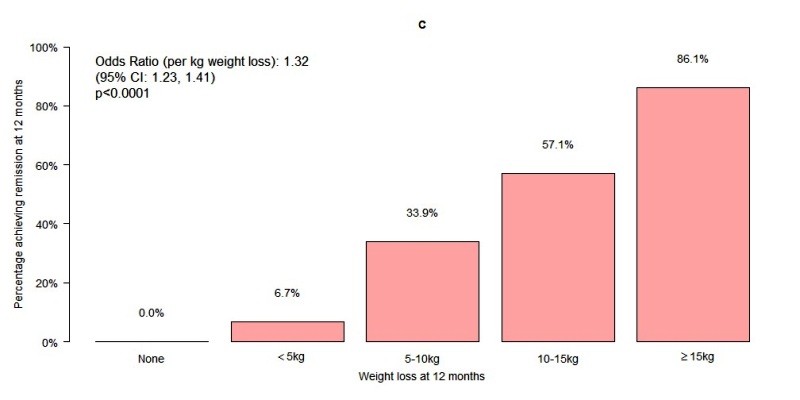
The most interesting presentation was from a Dietitian involved with the DiRECT trial, which has attracted the largest amount of research funding that Diabetes UK has ever awarded. The trial is intended to follow up an earlier 'Proof of Concept' trial that suggested that Type 2 Diabetes could be reversed with rapid weight loss, and this time they want to try and find out how it works, how much weight loss is needed, how long does reversal last, who might benefit the most from this approach and whether it can be achieved in primary care. Weight loss is achieved through Total Diet Replacement for 12 to 20 weeks (the Cambridge Weight Plan meal replacement products) with weekly or fortnightly review, followed by structured food reintroduction with fortnightly review, and there is also support in increasing physical activity. Monthly monitoring and support is provided to stabilise weight and prevent weight regain for two years.


There were relatively few participants (n=157) and the trial is not yet finished, but early results are impressive. Of the cohort who managed to lose 15kg or more, irrespective of their starting weight, 86% achieved remission from their diabetes at 12 months, defined as normalised blood glucose results (there are ongoing discussions about the definition of remission). Results were better for younger participants, lower starting HbA1c results and when the duration of diabetes was shorter. Unfortunately this exactly defines the people I don't see - in secondary care we generally see people who have had Type 2 Diabetes for some time and whose medication regimes are escalating and/or who are starting to get complications.

The last presentation of the day was from the doctor who leads the Diabetes service at the hospital we visited over the summer, talking about interpreting the data that we are starting to see coming from all these technological wonder-gadgets. One key point: we often advise a minimum of 4 blood glucose tests a day, but the evidence suggests this can generally only get people down to an HbA1c of about 69mmol/mol (8.5%). The target is often 53mmol/mol (7%) which would take at least 8 fingerprick tests a day, and for anything lower than this you're looking at micro-management using a CGM and pump or artificial pancreas system.

It was an interesting and informative day, but I continue to remind myself that despite the worth of the ideas being presented, there is in reality a negligible chance of making any changes to the service we offer, given that nothing has changed even after the whole team's visit to London.

Related Posts Plugin for WordPress, Blogger...