Showing posts with label university. Show all posts

Friday, 1 November 2013

An account of the past week or two

Pink flower
National Botanic Garden of Wales, May 2013
Let's start with some good news. Here are some bad things that haven't happened: the boiler hasn't broken down. The car hasn't needed any attention for nearly a week. There have been no work-related disasters.

My list of everyday tasks expands and contracts but never goes away. There has been progress of sorts - we have a date for installation of a new boiler, I have a certificate to prove I am not a criminal, and I have even managed to get proof of previous employment in the NHS back in the 1990's. This is useful because the amount of annual leave that one is entitled to depends on duration of employment, and it doesn't matter when that employment took place, so I should get a few more days holiday as a result.

On the down side, I haven't had any firm offer of employment so I haven't been able to give my notice in, and it is now looking as though I will therefore have to work through Christmas; I am nowhere near dealing with the Will or the Power of Attorney that I have been determined to set up for several years now, and there are some other jobs that look like they will be pushed further and further into the future. Income tax self-assessment form? Forget it.

The employment situation becomes ever more complicated. Why is it never straightforward? I got a call last thing on Friday as I was driving home last week, saying that there were more hours available to add to the 20 hours in one of the prospective new jobs, and then the voicemail message was cut off. An exciting prospect - perhaps this would be enough to make up a full time job together with the one day I've been offered by the other employer?

I had to wait until Monday to get more details. It took nearly a whole day of phoning and leaving a message, followed by not being able to answer the phone when it rang, then leaving another message, then being with a patient again when the return call came through, and so on throughout the day. Eventually we managed to find a time when both of us could speak, and of course the extra hours turned out to be on the same day as I had been offered for the one-day job.

Pros: four days with one employer is better than three with one and one with another, and it would cut out all the travel. Cons: the one day job would be doing education for people with Type 2 diabetes which is something a bit different that I'd actually like to do; I've said I'll take the one day job and don't like to mess people around; the extra hours tacked on to the 20-hour job would have to be taken on trust because that offer can't be put in writing. Watch this space.

I have been given the extension to the deadline for my Masters module that I asked for, and spent the whole of last weekend working on it. Really and truly, the whole weekend, except for a couple of hours watching La Vie En Rose, a biopic of the life of Edith Piaf, and a trip to the shops for provisions. I was able to do this due to the absence of Mr A, who is on a Bulgarian Biking Bonanza for a week. He returns very soon, and I await the thrilling tales of excitement and adventure. As far as I know, he hasn't broken anything, but I doubt that he would mention it if he had - he would just return home in plaster as a lovely surprise.

There is more to do for the stupid Masters module, which is taking up a disproportionate amount of leisure time, to the extent that I have decided to use work time to do it as well. Studying as a full time student was wonderful; combining it with a full time job is not so much fun. Just a couple more weeks of pain and it will be over - I do wonder whether I can be bothered to put myself through this for all the other modules necessary for the degree, but I imagine when the memory of this module has faded I shall miss the learning experience.

I am doing a fair bit of learning through everyday work, because I always want to make sure I'm on top of the game. A chance remark by one of the nurses set me thinking about the effect of caffeine on control of blood sugars in diabetes, and I chanced upon a recent paper which investigated just that. In case you're interested, it concludes that caffeine is bad for blood glucose control in Type 2 diabetes, and probably also in Type 1 and gestational diabetes. I'm not sure whether the paper is freely available because I accessed it through my university account, but if you're interested then look for "Whitehead N. & White H. (2013) Systematic review of randomised controlled trials of the effects of caffeine or caffeinated drinks on blood glucose concentrations and insulin sensitivity in people with diabetes mellitus. J Hum Nutr Diet." Or ask me, and I'll email it to you.

Speaking of gestational diabetes, those ladies keep on coming. I have had to deal with a glut of interpreters recently, some of whom have been truly awful, along with some very difficult patients who have been struggling both to understand what is being asked of them and to put it into practice. But some good news to finish with: at the end of today's clinic there was a lovely smiley lady whose interpreter hadn't arrived, but whose blood sugar record was near perfect and who indicated (with the help of family present) that she actually felt much better having made the recommended changes to her diet. That hardly ever happens, but so nice when it does!

Saturday, 28 September 2013

A tough week

Bikes racing in the park
Victoria Park, Leamington Spa, April 2013
My feet have hardly touched the ground for a week. Getting back from holiday led to a concentrated effort to get some of the more pressing jobs done around the house on Sunday, although there is plenty left to do. I was also anticipating a very full work schedule for this week, and copious amounts of preparation did seem to calm my frayed nerves, which enabled me to deal with everything.

Monday

I managed to navigate successfully to a Community Centre in the city to deliver the first session of my first Structured Education course. Structured Education describes evidence-based courses for groups of people with diabetes, delivering curriculum-led content designed to empower people to manage their diabetes more effectively. It is an intervention that, according to NICE, should be offered to anyone with diabetes, on the basis that the evidence suggests they those completing the course will be healthier, will need less time and resources, and therefore cost the NHS less money.

There are a number of different, validated Structured Education courses, and I guarantee I will be writing more about them in future. They are invariably known by an acronym or abbreviation: DAFNE, JUGGLE, BERT1E, EDWARD, T2ONIC, DESMOND and X-PERT - and there are more. Some are licensed nationally (and internationally), some have been developed by one diabetes centre in order to avoid paying licensing fees. In order to qualify for delivery within NICE guidelines, they must collect and collate evidence to demonstrate that they do in fact deliver positive results in terms of better diabetes management.

We deliver the course in pairs - one Diabetes Specialist Dietitian and one Diabetes Specialist Nurse. I was also being observed by my team leader to make sure I followed the teaching plan as documented (some of the other courses are very much more rigorous in their educator qualifications and peer review). Nine participants plus three carers were expected, and I was daunted by the prospect of such a large group, but as for all events of this sort, not everyone turned up. It went well, and I would almost go as far as to say that I enjoyed it.

Tuesday

On a different university campus I attended a preliminary meeting that introduced several Dietitians and Fitness Instructors to a European research project. It is a multi-centre, multi-national, 3-year project with the primary objective of discovering how two different dietary interventions affect the progression of people in a pre-diabetic state (with Impaired Fasting Glucose and Impaired Glucose Tolerance) to Type 2 diabetes. Secondary end points, no less important, incorporate two different exercise programmes alongside the dietary interventions, and also include assessing weight loss, CHD risk factors, quality of life and more.

The dietary interventions involve two diets that have previously been studied in other European projects (Diabetes Prevention Study and DioGenes): high protein and low glycaemic index (GI) compared with moderate protein and moderate GI. The hypotheses to be proved or disproved are a) that a high protein, high GI diet will be superior in preventing Type 2 diabetes compared with moderate protein, moderate GI diet, and b) that high intensity physical activity will be better than moderate intensity. I have provisionally put myself forward to conduct the dietetic aspect of the group sessions required within the project, but there are many barriers to my involvement, not least being that I am working full time at the moment, and I may be moving away from the region before the three years of the project are up.

Wednesday

The regular ante-natal clinic. I didn't have a great deal to do this time, but I was pleased that my thoughts about the treatment for one person I saw turned out to be supported by the more experienced members of the MDT. If blood glucose readings show high fasting levels first thing in the morning, this suggests adjustment to medication - if your blood glucose is on target when you go to bed but high in the morning, there isn't a lot of scope for fixing things with dietary intake.

I also went to see the convener of the Masters module. The date is approaching when the case study has to be handed in and I'm rather suffering from the pressure of it. It doesn't help that I can't do a great deal on my work PC because it uses such old technology and has various restrictions that prevent effective academic work, and I haven't had any Internet access at home all week because of some fault that can't be rectified easily because the landlord rather than the tenants has the contract with the ISP. I did get some very useful advice on where to focus my efforts with the case study, and with only two weeks to go before the deadline the pain will soon be over.

I also took a trip to the Islet Research Laboratory in Worcester in the evening, but I'm saving that report for a separate post.

Thursday

I attended a 'cross-site' dietetic meeting where Dietitians from the four corners of the Trust gathered to discuss various matters of import, and some other stuff. While we all sit under the umbrella of Dietetics, different disciplines are scattered in many places: Dietitians dealing with inpatients, home enteral feeding, paediatrics, hospital catering and diabetes all reside in different areas as well as being separated over the two hospital sites.

Some of the meeting was useful and interesting; some was not. The most interesting part was a discussion about Prescribing. At present, Dietitians are not legally able to prescribe Prescription Only Medicines (POMs), although we can prescribe nutritional supplements and tube feeding products which come under the heading of 'Borderline Substances.' Following a long drawn out process, Physiotherapists and Podiatrists have achieved a change in the law to allow them to prescribe (after a suitable Masters-level qualification has been awarded), and the BDA is following in their footsteps to try to bring about the same change for Dietitians.

If/when this comes about, it will make a great deal of difference in many dietetic settings. Most pressing is parenteral (intravenous) nutrition, where Dietitians make all the decisions about what should go into the parenteral feed and at what rate and for how long it should be administered, but have to find a doctor or a pharmacist to sign and take responsibility for the prescription, despite knowing nothing about its import. There are many other inpatient situations where it would make a big difference for the timeliness and efficiency of treatment if the Dietitian were able to prescribe, but in my line of work it would mean that a Dietitian could initiate and modify diabetes treatment. This would include tablets, injectable medications and insulin.

At present, it would be illegal for me to make or even to recommend any changes to the administration of a patient's insulin. We get round this by making sure that all I do is discuss what might be done and suggest that the patient decides whether to make a change or not. For example, repeated low blood glucose levels in the early hours of the morning in the absence of other factors might suggest that the basal rate of insulin overnight is too high. I could ask the patient what they thought they might do about that. Decrease the basal rate? That sounds like a good idea.

There are four defined levels of prescribing rights, starting at a Patient Specific Direction which allows a non-prescriber to supply and administer a specific dose of a named drug via a specified route for a named patient. Next up is the Patient Group Direction (PGD), which allows for a wider range of options to supply and administer specific drugs to classes of patients. The diabetes service in my Trust is working to draw up a PGD - it isn't entirely straightforward. What we hope to gain in future is firstly 'Supplementary Prescribing', which is fairly limited but allows prescribing of POMs according to a clinical management plan agreed by doctor, patient and prescriber. The end goal is to become 'Independent Prescribers', where no permission is needed from anyone.

Both supplementary and independent prescribing allow for complete access to the entire formulary of medicines available for prescription in the UK. It is not surprising, therefore, that there is significant work to be done to elicit approval of prescribing rights for Dietitians, including the amendment of an Act of Parliament. It is a worthy goal, but even if achieved it would only be available to a very few of the most senior Dietitians, not least because of the cost and difficulty of the Prescribing qualification, and the burden of such serious responsibility.

Friday

A much easier day ends a week in which my weekday house suffered the breakdown of the fridge freezer (it was replaced but all my frozen food was lost) and no Internet access. I have had to spend significant time after work and in the Medical Library during the week in order to research my case study and do all the other online tasks that are essential in this modern world. I am not optimistic that home Internet service will be resumed next week, but you never know.


Sunday, 19 May 2013

Back to school

Astronaut
Deutches Museum, Munich, March 2013
I spent two days last week at university: "Learning Beyond Registration - Diabetes 1". The registration that I'm learning beyond is that issued by the Health and Care Professions Council, which is the regulatory body for the Dietetics profession. The module can stand alone, or can form part of a Masters qualification.

Teaching is done at the university where I studied for my Dietetics degree, and the campus has changed surprisingly in two years. There is a big hole where one building used to be, there is a whole new building where there used to be an open space, there is a brand new cafe and shop, and various other upgrades to facilities, including pay and display parking which used to be free. It was also quite sunny and the cherry blossom was in full bloom, showing off the beauty of the countryside campus to full effect.

There are five of us taking this module, where in previous years there have been many more (I think a previous class of more than thirty was mentioned). Five was a good number, and three of the others had less experience than I do; we all had lots of opportunities to ask questions. In fact, day 2 was spent with an experienced diabetes Dietitian doing nothing but asking question after question.

Day 1 was more structured. The morning covered the evidence base, including a very useful document that summarises all the evidence behind the nutritional guidance that is applicable to diabetes. In the afternoon we went over the evidence of increased cardiovascular risks associated with both Type 1 and Type 2 diabetes with a very knowledgeable Dietitian from London, as well as looking at the different medications available and some of their side effects. We ran out of time at the end and skipped through insulin pumps, which was fine because I know quite a lot about pumps.

Day 2 was my perfect day. From 9 am until 4 pm we talked about anything and everything about diabetes - insulin, weight management, carbohydrate counting, glycaemic index, alcohol, physical activity, renal function and lots more. The role of the multi-disciplinary team, prescribing, low calorie and very low calorie diets, low carb vs low fat diets, the latest 5:2 'Fast' diet, glucose metabolism and competitive sport, glycaemic rebound following a hypo, the dawn phenomenon, glycaemic profile after alcohol or activity, matching insulin profiles against individual requirements, the use of 'old' vs 'new' insulins and their cost, the comparative cost of other medications, working with difficult patients (and colleagues), gestational diabetes, enteral and parenteral feeds with insulin, educational resources, new technologies like Skype clinics, different blood glucose meters, issues to consider on holiday (especially an activity holiday), and there was probably more.

After some careful discussion, I think I have got to the bottom of the meaning of the statement that if the same total amount of carbohydrate is consumed, then "sugar does not raise blood glucose levels any higher than starch". What it seems to mean is that the total amount of glucose that reaches the bloodstream is the same for a portion of sugar and a portion of starch that contain the same amount of carbohydrate - the body does not distinguish between the glucose that is derived from digestion of sugar compared with the glucose derived from the digestion of starch. But sugar is digested faster and reaches the bloodstream quicker than starch, so produces a sharper peak in blood glucose post-ingestion, especially if in liquid form, even if the total impact on blood sugar (the area under the graph of blood glucose plotted against time) is the same for both curves. This post-prandial peak seems to be the most harmful aspect of glycaemic control in diabetes, according to the experts, and subcutaneous insulin isn't quick enough to deal adequately with a sugar peak.

Having said all that, the total amount of sugar in most foods we eat is usually less than the total amount of starch - compare a serving of honey (1 tbsp = 15g) with the serving of bread (1 slice = 40g) that accompanies it. Even with bread at 50% carbohydrate and honey at 85%, you're still getting a bigger hit of starch than sugar overall. So having a little bit of honey on your toast isn't too bad, but drinking non-diet Coke is not advised. Except to treat a hypo.

The next stage in the module, after I've properly consolidated what we learned (more formally than just writing a blog post), is to find myself a case study and start writing it up. We have another two days taught in July including an assessed presentation, then the case study has to be ready in October.

There will now be a short break while Mr A and I go on holiday...

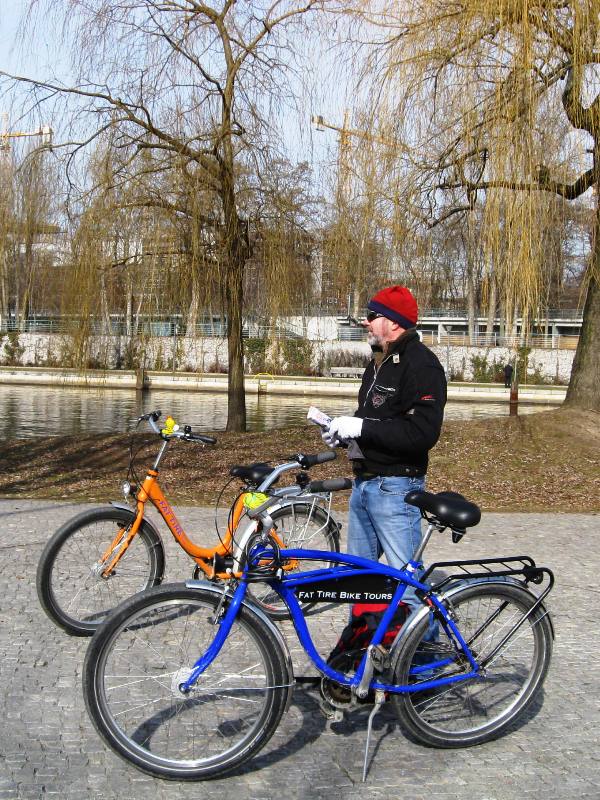
Mr A and our rented bicycles

Related Posts Plugin for WordPress, Blogger...