Tuesday, 28 May 2019

Getting wired and plastered

Son of Ulf and Sidekick posing for the camera
Son of Ulf and Sidekick, May 2019
There's been some satisfying progress with the Lola Towers Renovation Project. The last remaining large indoor job within Phase 1 is to strip, plaster and paint the walls and ceiling of the main living room, stairs and upstairs landing.

Ilf removed all the wallpaper a while ago. That was a major operation, and one that I don't think he relished - the wallpaper was old and the underlying plaster crumbly. Then I chased both the electrician and the plasterer for a while before pinning them down on dates.

Bill the Electrician came with his assistant plus a lad on work experience, dug out new sockets and put in wiring for a second overhead light and switch, but left me with only one usable light and one socket in the room. He told me that the plasterer would find it much easier this way, and he'd come back afterwards and finish it all off.

My chosen plasterer was Son of Ulf, who previously did a beautiful job on the plastering for the kitchen and picks up extra work at weekends and in the evenings while working with Ulf in his day job. He has a Sidekick who is even younger than he is. They ate a whole packet of biscuits in about 15 minutes on the first day, and they made a terrible mess of my parquet floor downstairs. I supervised quite closely on the protection for the new carpet in the upstairs hall.

Electric Bill took his time for the return visit, leaving me with the single light and one socket in the room for a week or two - not that I wanted to use the room until I'd at least cleaned up the floor. When they returned they found that Sons of Ulf had completely plastered over one of the new sockets and they had to dig it out again with much complaining.

Ilf has come round to view the work with approval and, I think, a hint of envy. I have spent much of my spare time in the time since the job was finished in cleaning the dust and plaster residue from every surface in the entire house. It is a time-consuming and filthy job. I have contracted out most of the time-consuming and filthy jobs within the scope of the LTRP, but cleaning is one thing that I feel I ought to do myself. This may be because I don't (yet) employ a cleaner.

Ilf is busy for several months and gave me a date quite a long way into the future for the painting. I commented that I could probably make a start on the undercoat myself, and while he gave me a couple of tips I could sense that he doubted my competence for this task. Given that I'm having trouble finding time to simply clean the mess made by the plastering, I'm not sure he need worry about me making much progress before he's able to come back.

[On an entirely separate note, I was browsing some old blog posts in nostalgic mood and was horrified to discover that the Brexit referendum took place before I'd even seen the architect, let alone started work on the new kitchen. Politics has been grim for so long that it's hard to remember a time before Brexit.]

Tuesday, 21 May 2019

Libre update

Libre handset showing 5.6 mmol/L and downward trend arrow

While I was away in Brazil and for the last four blog posts, it's been quite an exciting time in the world of diabetes. The Libre flash glucose monitoring system, which a few short weeks ago was almost unobtainable, has now become very obtainable indeed.

There have been new (draft) guidelines that are much more inclusive than the previous ones, so that instead of almost nobody being eligible, almost everyone meets the criteria now. There has been a meeting attended by someone from the Trust who says we can go ahead and start as many people on it as we like, despite the guidelines only being in draft.

The situation is not completely relaxed though, because there is supposed to be some sort of monitoring and review of our patients to whom we give the Libre to make sure that it is having the positive effect that is claimed for it. Understandably the CCG does not want people to have a new and expensive bit of kit and then not get the benefit, which from their point of view involves a cost saving due to better blood glucose management reducing long-term health complications, and fewer prescribed blood glucose monitoring strips.

We are planning to use an online dashboard to collect information for us to review, whereby patients upload the data from their devices and we view lots of lovely graphs as well as recording auditable data. We can then report back to the CCG and support patients who are getting good results while recommending the withdrawal of the device from those who aren't using it or aren't getting any benefit or aren't using fewer strips.

And there has been a meeting with the suppliers, who gave us all a handset and sensor to wear for the next two weeks. I was delighted to be able to try some of the technology on my own non-diabetic body, although my nurse colleagues weren't very keen at all. We're all very used to looking at blood glucose results from our diabetic patients and being asked whether they are cause for concern without knowing anything about what is 'normal'. How high does blood glucose go after a high-carb meal when you haven't got diabetes? I was about to find out.

I managed to upload my data from the device (which wasn't anywhere near as straightforward as the suppliers led us to believe), and I even registered as a pretend patient with our service so that in theory I should be able to see my data both as a patient and as a Healthcare Professional. We all enthusiastically checked our glucose levels, and it has been mightily interesting. We used to say that without diabetes, fasting blood glucose levels are normally between 4 and 7 mmol/L, but we've never really known what a 'normal' post-prandial peak looks like, although pregnant women are set a threshold of 7.8 mmol/L one hour after a meal.

It turns out that our post-prandial peaks are often much higher than this - I managed to reach 12 mmol/L after a particularly nice lunch - but we do tend to come back down very quickly and stabilise within range. We also found that the sensor told us that we all drop below 4 mmol/L at some point in the night, which for someone with diabetes is classed as an unwanted night time hypo. The Libre license requires you to check blood glucose at hypo levels, but I couldn't check the 'real' state of affairs because I didn't have any blood glucose testing equipment, which someone with diabetes would have.

It was all going well and I was looking forward to seeing what happened when I played badminton, except that on Sunday night, after less than a week, the sensor came off when I removed my jumper. So that was disappointing, but it's also useful information to know that the glue isn't quite as sticky as we would hope. When I came back to work, I found that my nurse colleagues had become bored of the whole thing and had deliberately taken their sensors off after less than a week. More useful information about how patients might behave.

Glucose monitoring graph showing night time hypos

Then, about a week later, I was chatting to the paediatric diabetes team, and they told me that there was a stash of sensors in the department that I didn't know about. This time I put one on the other arm, and it has been behaving rather differently. It no longer shows overnight low glucose, in fact overnight is a very stable time when I sit comfortably around 5 mmol/L. So either there is a variation in the sensitivity from one sensor to another (Mr M's theory) or it matters which arm hosts the sensor because pressure on the sensor during the night is likely to confound its sampling.

Libre graph showing no night time hypos

So I did get to wear a sensor for badminton after all, and nothing whatever happened - no downward trend in the glucose level at all. Managing carbohydrate, insulin and blood glucose around exercise is one of the things that people who inject insulin find very difficult to manage, and the rest of us don't even notice.

I have three days to go on the second sensor, and in fact I'm now checking it less often and finding the results less interesting. The first group of actual patients with Type 1 Diabetes have now been given their sensors - unsurprisingly, everyone who had been invited turned up - and I think the second group session in June is already full. We anticipate that after this initial spike in demand everyone who wants one will have one, and we can go back to normal levels of patient apathy and non-attendance.

Wednesday, 15 May 2019

What I've been reading

Image of the book cover

Lord Hornblower
by C. S. Forester
"Horatio Hornblower must rescue a man he knows to be a tyrant from the mutiny of his crew - a dubious chore, but one that leads Hornblower, with the aid of his old love, Marie, to the glorious conclusion of his own battle with Napoleon."
Despite not understanding any of the nautical or military content as usual, it's still a good yarn. It's obvious he can't be executed because a) he's the hero and b) there are more books, but how does he escape? I spotted the twist at the end for a change.


Image of the book cover

Relativity for the Layman
by James A. Coleman
"A simplified account of the history, theory, and proofs of Einstein's revolutionary conception of the universe."
With an endorsement by Einstein himself on the inside front cover, this was written in 1959, before any space exploration had taken place. A fascinating historical snapshot as well as a lucid and comprehensible explanation of the General and Special Theories. It includes the question of whether there could be a star so dense that light couldn't escape from its gravitational field...


Image of the book cover

The Gun
by C. S. Forester
"It is the time of Napoleon. The Spaniards are fighting a desperate, protracted, bitter and merciless guerilla war. Into the hands of a guerilla band falls a remarkable cannon, an 18-pounder that transforms the rebels into a besieging army."
Not a Hornblower saga, this small book relates presumably an imagined course of events within the framework of Napoleon's campaign in Spain, with Wellington fighting on the English front. The hero of the book is the eponymous gun, and the tales of its journey, its use and its demise are perfect reading for the traveller.


Image of the book cover

A House for Mr Biswas
by V. S. Naipal

narrated by Sam Dastor
"Born into poverty, then trapped in the shackles of charity and gratitude, Mr. Biswas loathes his wife and her wealthy family, upon whom he is dependent, and longs for a house he can call his own."
A long rambling book telling the story of the life of Mr Biswas - he is consistently called Mr Biswas even when he is a child - who is from an Indian family living in Trinidad. He is often touched by tragedy, many times through his own neglect or incompetence, and usually comes off worst in financial deals throughout his life. The book ends with his early death at the age of 46, but I was left wondering what was to become of his family, as he had failed to repay the loan on the house which is due any day.

Wednesday, 8 May 2019

Amazonia part 2 and Paraty

Heart shaped water-filled seed pod on the forest floor
Amazonia, April 2019
So my forest comrades had set off back to Manaus, and I was still in the Amazon jungle. My new companions were a young Israeli man and a Serbian couple who live in London, but they weren't in the same league as the friends who had just departed. This was the 'local homestay' part of the trip, and unfortunately it was the worst part of the whole holiday.

The local house we were to stay in turned out to be the home of one of Moses's brothers and his family. We were first taken to a local bar - not so much for our benefit I suspect, but because it was Saturday afternoon and Moses got to hang out with his mates. There was a football game going on which was joined by our football-mad Israeli, and it was interesting for a while to see people gathering, having a drink, there was a barber there cutting hair and I could glean a little from the TV in the background. But we were left there for a good deal too long before going back to the house for supper, which was chicken and rice again, and nice enough. There was virtually no interaction with the host family, however.

We were back sleeping in hammocks, but this time inside the house. By 7.30 p.m. it was dark, and Moses left us with a cheery wave and 'see you in the morning'. There were no chairs, and with no time to get to know one another I made a bit of an effort at conversation, but the other three didn't seem to want to chat, and the electric light went off at 8.30 p.m. After this second experience in a hammock I joined the dots - literally - and realised that my bites weren't necessarily from mosquitoes. Altogether I was glad to get back to the lodge for breakfast, even though it was now raining.

Deck alongside the river with hard chairs and resting dog
The next trip was to a local centre that contained the school that Moses had attended, which he said contained about 225 pupils, a shop, a doctor's surgery, a dentist and two churches. It was Sunday so the school was closed, there was a service going on in one of the churches, and there wasn't much else to see. After lunch the four of us went on another boat trip with Moses and saw more monkeys, birds and a quick glimpse of a snake before it plopped into the water. Despite the rain it was a three-shower day for me - I was hot, sticky, itchy, and yearning for a comfortable place to sit. I really would have been happy to go home there and then, but there was one trip more next day.

This time I went out into the forest with a different guide plus three Russians. Although we covered much the same ground as with Moses and saw many of the same things, there were still new experiences and lots to see. My main regret through the whole trip was not to have binoculars - the bird life was spectacular - and next time I'd take a cushion.

The trip back to Manaus was quick and efficient, and although this time it wasn't raining I still couldn't get a decent view of the Encontro das Aguas. Back at the hostel (soft chairs! bliss!) they let me hang out for a small fee to use the facilities because the flight back to Rio was at 2 a.m. I showered, repacked, went for a wander and bought some provisions for the flight, and was inundated by everyone's photos now that I was back in range of wifi. Ina and the unnamed Italian were still around so we chatted, and then the hostel called me an Uber and I was off to the airport. The driver was a P.E. teacher by day and driver by night - we couldn't communicate much but I can now add Uber to the list of transport options during the fortnight's holiday.

The next 15 hours or so were spent on the move. First the flight from Manaus to Rio with a transfer in Brasilia. Then I took a taxi from the airport to the busy and confusing coach station, where at least twenty different bus companies were offering tickets to various destinations, and where the maximum cocoa content of the chocolate in the sweet shop was 40%. Brazil's mass market chocolate really isn't much good considering that they grow their own cocoa beans. From the coach station it was a four and a half hour journey to Paraty in a comfortable air-conditioned bus. I was met at the bus station by T, my friend from school days.

8 packets of Brazilian soups
Souvenir soup
We went for a short walk around the town before T said he needed to buy a few provisions and was it all right if we stopped at a supermarket? He had no idea what he was letting himself in for, and after I'd pestered him to death about all the unfamiliar fresh produce he excused himself and escaped outside to make a few calls while I continued to browse the shelves, adding a few more interesting soups to my previous haul. Then we drove back to his house, which was about 30 minutes out of town up the mountain. T was very pleased to receive my gifts of Branston pickle, Piccalilli and Heinz Sandwich Spread, and I was very pleased not to be carrying them in my rucksack any more.

Bright blue and green birds
Watching birds from the balcony
I went to bed early and slept late, relishing the comfortable bed and slightly lower temperatures, even though it was still very humid and not sunny. I'd hoped to do a bit of laundry, but it would never have dried and I didn't fancy wearing or returning home with damp clothes. We didn't do much that day or the next except chat, mostly about Trump, Assange, Bolsonaro and Brexit. T isn't planning to come back to Britain, but despite this he is extremely vocal about the state of the UK and its government and politics. I sat on the balcony overlooking the Atlantic forest, watched the birds and meditated a little.

Greenish birds
Watching other birds from the balcony
T drove me to a local restaurant with a huge garden where I begged for a salad, after which we shared the traditional Brazilian dish feijoada, which is a bean stew with pork and beef in it, eaten in this case with rice and kale. It was delicious, but afterwards I found I was completely unable to eat anything else that evening or for the whole of the next day. It might have just been a reaction to the stress I'd put my body through. In the Amazon particularly I had been finding the heat, humidity and itching from the bites almost unbearable, as well as the discomfort of sitting on hard seats with no backs all the time.

I felt a bit more robust on Friday, and T had things to do, so I took a local bus into Paraty and joined a guided tour, where I was the only participant. The town was settled by the Portuguese in the 16th century, and prospered when it found itself on the route for export of gold that had been discovered further inland. When the gold started being exported via an alternative route Paraty continued to handle coffee and slaves, but today the historical town centre is preserved and the main trade is tourism and production of the local cachaça spirit. I wandered around a bit and found my first chocolate shop that had what I would describe as a decent selection, before catching the bus back to T's house.

Smartly painted two storey house with pineapple details
Paraty house
That was the end of the trip bar the 24 hours it took to get home: T took me to the bus station for the coach back to Rio, I found a local bus from the bus station to the airport, and spent some of my remaining local currency in the airport on the most overpriced sandwich I think I've ever had. I couldn't sleep at all on the long trans-Atlantic flight and managed less than an hour during the 5-hour stopover in Paris. From Birmingham I caught the train home and walked from the station. It was freezing! And how welcome that was!

I was happy with how much I'd seen in two weeks in such an enormous country. There is plenty more if I should choose to go back - a notable landmark I chose not to visit is the Iguaçu Falls, on the border with Argentina and apparently more impressive than Niagara. The Pantanal wetlands in the south-west holds an enormous variety of wildlife, the historic towns of Recife and Salvador on the north-east coast sound interesting, and there's always Fortaleza where I have been offered a homestay, and the cities of Brasilia and Sao Paolo. Now that I've had the nasty yellow fever vaccination I ought to make the most of it. We'll see.

T and me at the bus station with a backdrop of mountains
I haven't got any better at taking selfies

Thursday, 2 May 2019

Amazonia part 1

Thatched shelter, fire, four of us eating in a forest clearning
Forest camp, Amazonia, April 2019
Without doubt, the middle section in Amazonia was the best part of the holiday. Not just because of the setting and the sights, but because of the people that I met. Seven of us were booked to start the organised trip at the same time, but four of us were there for three days, two for four days, and only me for the five day option.

But before that trip started I was collected at Manaus airport and taken to my accommodation that night: an actual hostel, the sort that proper backpackers use (although I had a private room, with en suite and aircon! Bliss!) At reception I was asked if I was a backpacker, and I didn't know what to say. Does a rucksack instead of a suitcase qualify you to be a backpacker? If so, then yes I am! If staying in a hotel in Rio and then a private room in a hostel disqualifies you, then no. They also took a photo of me at reception. I imagine it's handy in case you don't come back from some ill advised excursion that backpackers might choose to go on.
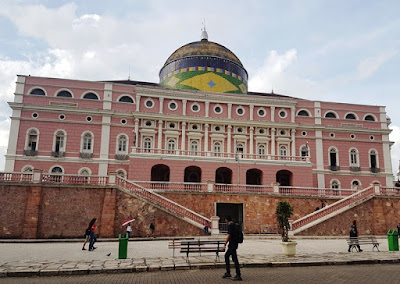
Magnificent pink tiled building with dome in the colours of the Brazilian flag
Teatro Amazonas, Manaus
There was still some daylight left so I wandered down to the port and the produce market, but it was hotter and even more humid than Rio, too late for much produce to be on display, and it didn't feel like a very safe part of town. It was also too late to explore the magnificent Teatro Amazonas opera house. I was told that the city was booming since President Bolsonaro had taken office because of industry incentives, but the centre was still shabby and didn't seem to be very prosperous. Then I had some packing to do, because I was going to leave a whole lot of stuff in the tour office while I was on my Jungle Adventure.

I was collected early next morning. The first leg of the trip was a 40 minute car drive out of town to the ferry which would take us across the 'meeting of the waters' (Encontro das Aguas) - where the black Rio Negro meets the brown Amazon and the waters don't mix. If it hadn't been pouring with rain then the boat's plastic windows wouldn't have been firmly lashed down and we might have had a better view, but I got the idea and it was fairly impressive despite the limitations. There are many good pictures on the Internet if you have a look.

Two boats waiting at a jetty
The end of the road
On the other side a van was waiting to take us to the end of the road, which took about an hour. It did stop raining at this point, but no let up from the heat and humidity, and this was the last point for five days that I had a soft seat to sit on. At the end of the road we were taken by boat to the Juma Lake Inn, where lunch was waiting. Meals comprised rice, beans with chicken or fish and sometimes salad or vegetables or fruit. It wasn't fancy but it tasted fine. Not being a coffee drinker, I was limited to water - not just for this section of the trip but pretty much for two whole weeks, apart from a few bowls of Redbush tea towards the end (I had to use a bowl because T's coffee cups were too small).

I should introduce my Amazonian companions. My favourite by far was Thomas, a young Dutch graduate who had completed a law degree and was taking the opportunity to travel for a few months before moving to Amsterdam and getting a job. I am very much hoping to stay in touch with Thomas, but three days together in the Amazon may not be an indicator of a long term friendship. We'll see.

A leaf-shaped grasshopper in Ina's hair
Ina and an insect
Then there was Ina from Austria who was a bartender and waitress, and her Italian travelling companion whose name I shall never know. When we were introduced I'm sure he said Jonathan, or John, but later I thought someone called him George, and elsewhere I saw it written as Schorsch, but by the time I realised I had no idea what his name was it was much too late to admit it. He was a reckless youth who had no sense of his own mortality. While we were loitering deep in the jungle watching what our guide was about to show us, he was wandering off the path poking a stick into holes in the hope of dislodging a snake, scorpion, spider or other potential hazard. While we watched, Ina said thoughtfully, "I think that he would definitely die first." Ina was lovely.

Me, Ina and Rosel wearing crowns woven from palm fronds
Crowns for the ladies
There was also a heavily tattooed Swedish man called Alex who turned out to have Type 1 diabetes. I discovered this when he took out an insulin pen and injected himself in a way that was very unlike how an insulin pen should be used. This turned out to be because he had left half his diabetes supplies on a bus in Bolivia so now he was rationing his needle use and the needle was a bit old. He also told us about being mugged after coming out of a tattoo shop in Columbia onto a quiet street a bit too late in the evening. "This is why they take your picture at the hostel," I thought.

All the above people were in the 20-30 year-old age bracket, but the last two in our party were 75-year-old travelling companions from Germany, Rosel and Rolf. They were game for the boat trips and jungle walks but drew the line at the optional nights in hammocks and came back to their beds in the lodge on those days.

Moses peeling Brazil nuts with a machete
Our guide introduced himself as Moses, and we found out more about him as the days went on. He was a local lad, born and raised on the river quite close by, with five brothers and two sisters. He had never left Brazil and his English was atrocious, presumably picked up from TV and tourists. I could make out about 70% of what he was saying and I'm pretty good at English; I can't imagine what the others managed to understand with English as their second language. He was a huge practical joker though, with a big grin which made up for his linguistic deficiencies, and he did know his stuff - where to find caimans and monkeys as well as other wildlife and plants. I had a substitute guide on my last day whose English was really good, so I could ask him some of the more complicated questions about the environment and climate change, but I wouldn't have swapped him for Moses the rest of the time.

The lodge is situated on a tributary of the Amazon, the Mamori river, next to Juma Lake. That first afternoon we went out piranha fishing, each with a makeshift bamboo rod, line and hook. Moses had a bit of trouble finding piranhas for us - the first two locations he tried were piranha-free, but the third was a winner. I caught a fish for the first and last time, and Moses helped me to put it back in the water. The three boys went mad for fishing and could hardly be torn away while one of them hadn't caught the biggest or as many as the others. We kept the largest fish, and they were cooked for us. Verdict: bony.

Small crocodilian being held by the neck and tail
Caiman
Moses caught a small caiman and brought it back so we could see it properly. He reckoned it was about five years old, and when he opened its mouth you could see there was no tongue. That poor creature was passed from hand to hand for photographs until eventually it was allowed back into the river.

We went out again at sunset although it was too cloudy for a good view of the sun going down. On this little trip we approached a tree that was covered in roosting white egrets or herons and black cormorants. As we approached they all flew off, black one way and white the other. which made me recall drawings by M. C. Escher which I have now looked up (this one, and this one). The reflections and depth of the river also put me in mind of Escher's drawings of reflections in pools of water.
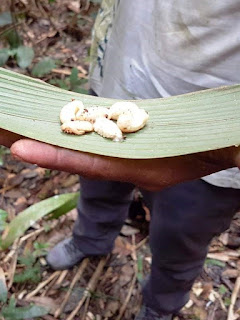
Six fat white larvae on a palm leaf
Larvae
We were invited to get up early next morning for a trip to see the sunrise, but again there was too much cloud for it to be a spectacular sight. We did see vultures perched and soaring, a hawk catching a fish, and pink and grey river dolphins - not much of them and quite a way off, but exciting enough for me, and some of the grey dolphins hung around in the river right in front of the lodge.

After breakfast we were taken for a forest walk, which allowed Moses to show us lots of the different plants, trees and animals but also gave him full rein to play as many tricks on us as he could manage. He pretended he was going to spike me with a huge thorn, and that he was going to throw a spear at Ina, and tried to frighten us with spiders, encouraged us to try climbing a tree, showed us how to use ants as insect repellent, made palm crowns for the ladies and bracelets for all of us, and sliced open coconuts to reveal fat white larvae that he skewered and 'cooked' using shavings from an oil-rich palm. We saw Capuchin monkeys high in the trees, an electric eel in a shallow stream, and many forest berries and plants and their uses.

A roiw of hammocks under a thatched roof
The camp bedroom
That night was when five of us (plus Moses) were going to sleep in hammocks in the jungle. The hammocks were made of thick blanket material, smelled foul and were slightly damp due to the humidity and being kept in large sacks. Mosquito nets were loosely fitted over the top of these and hung to the floor. We strung them up under a thatched canopy, then were sent to fetch wood for the fire and help prepare the supper. It wasn't long before a large black caiman, the dangerous type, was circling by the shore, no doubt attracted by the bits of chicken Moses was throwing into the water.

Nose and eyes of a caiman above the water
Black caiman
Moses made us a tablecloth of woven palm fronds, constructed a griddle for cooking the chicken as well as staves to hold it up and to hold the pan of water for the rice. The dinner was surprisingly well cooked, and then we went out for a boat trip in the darkness, under a brilliant starry night sky. Moses caught three large fish with his torch and spear - he said the torch picks out their eyes under the water. We also saw a huge tarantula on a tree trunk.

Huge black hairy spider
Tarantula on a tree trunk
Back at camp the caipirinha cocktails started to flow, my nameless Italian demonstrated a pyromaniac tendency and nearly ignited the fire shelter roof, Ina started to sing and everybody was in fine spirits. The group bonded. We would never find such good companions, this was the best way to live, travelling stories abounded - mine from thirty years ago, but still, we could compare modern times with the olden days. No mobile phones, no Skype, no WhatsApp, no Internet - true isolation that's hard for the current travelling generation to imagine. I was reminded about what I love about travelling, and why I should do it more often, even while my old bones ached for something soft to sit on.
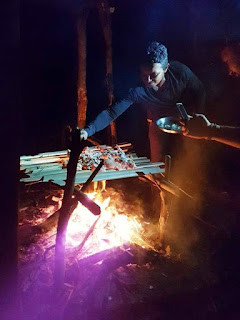
Fire highlighting the face of Moses as he tends the barbeque
Moses tending the grill
I had done pretty well with my insect repellent up to this point, and had escaped with just a few random bites. The morning after the night in the forest I had acquired many, many more. With hindsight, that hammock was the culprit, no doubt harbouring all manner of biting insects, and the last few bites are still troubling me. At the time I hadn't considered this, and assumed that it was just a failure of my mosquito net. Anyway, I've had better nights' sleep especially as Alex had a powerful snore, but in the morning we cleared out and came back to the lodge for breakfast, after which I caught up with some sleep before our next outing, to a nearby house where a family made their living from their land. And, presumably, from their tourist visitors.

They grew produce of all kinds - mango and passion fruit, Brazil nuts, onions, cacao and a whole lot more. They had a small scale mill for manioc (cassava) flour, generally known as farinha, which when mixed with butter or oil makes farofa and is sprinkled on every dish. I'm sure that the bread at the lodge was made from farinha rather than wheat flour - it had that gluten-free cakey texture. There was mimosa, and biting ants, and I tasted my first Brazil nut straight from the tree.

After this outing and the first rain we'd had since getting there, sadly my four forest companions headed back for Manaus and further travels of their own. I was genuinely sorry to see them go. But I was staying for another two days, so I would no doubt meet alternative travel companions.

Four smiling in our boat
Moses, Ina, Nameless Italian, Thomas

Saturday, 27 April 2019

Rio de Janeiro

Sandy and rocky coastline from above
View from Pão de Açúcar to Copacabana beach, April 2019
I pondered whether to write this for you, the reader, or for me. Written for me it would be a long account of where I went, what I did, how it looked and felt - so I could look back and remember how it was. That, however, would be tedious to for anyone else to read, and this is a public blog after all, not my journal. So it will be an edited account of the highlights, with a great deal missing to try and entertain as well as recall the experience.

Floor to ceiling stained glass window from inside the cathedral
Catedral Metropolitana
It's a long journey from the UK to Brazil, not least because direct flights are disproportionately expensive, so the first leg is eastwards with a long stopover. On arrival in Rio the international airport has surprisingly little assistance for the international traveller. I took a bus into town, and made my first friend - a student who was excited to practise her English as she was studying to be a journalist, and was taking time out of university to visit Rio in order to see her favourite band - the Arctic Monkeys. She was delightful - in the course of the journey we became Facebook friends, her mother invited me to stay in her home town (which I would not be visiting on this trip), I invited her to stay in Leamington Spa (which I very much doubt she will ever visit), and she helped me to negotiate my bus stop in town with the driver. A good start.

Gilded finials and columns
Teatro Municipal
The weather in Rio in April is not unbearably hot but it is very humid. By the time I reached the hotel I was definitely in need of a shower. Luckily the room was ready, I could shower and change, and there was wifi and air conditioning. I booked a van up to the summit of Corcovado mountain where the Christ the Redeemer statue is, and made my way to the Metro via the Cathedral, which is in the shape of a cone made of grey concrete and is probably the ugliest cathedral I have ever seen, aside from its four enormous stained glass windows. I also passed through Cinelandia square, where the gilded and domed Municipal Theatre is located.

The statue of Christ with outstretched arms
Cristo Redentor
The journey to Cristo Redentor from the Metro station takes two vans, a lift and an escalator or steps. The view from the summit is 360 degrees of Rio de Janeiro, and served as useful orientation as I planned the next two days. I was lucky that the weather was fine - when I passed through Rio on my way back the summit was hidden in the clouds. There isn't much to do at the top after you've looked at the statue and the view, but I had some lunch with that view, and at the next level down I went round a small museum about the local geology, flora and fauna, and then took the van and Metro back.

The hotel breakfast was buffet style, including normal breakfast cereal, bread, cheese and meats, sausage and egg, but also a variety of buns and cakes. Of course I felt obliged to try everything, and collected enough to take with me for lunches as well. The heat and humidity meant that I wasn't all that hungry, and going out alone in the evening to a restaurant didn't appeal, so it was pleasant to indulge at breakfast.

Marmoset running along a fence wire
Sugarloaf ascent
After breakfast on Monday I was notified by the walking tour company that the tour I'd booked for that morning was cancelled, so I booked up for the following day and went to the Sugarloaf mountain instead. This time I attempted to catch a local bus, which went pretty well although I overshot my stop and had to walk back.

The ascent is in two stages both served by cable cars, but you can walk up to the middle station through the forest if you like, so obviously that's what I did. Apart from the views of the bay and Copacabana and Ipanema beaches at the top there's a nature trail through a bit more forest. There are notices all over the place about not feeding the marmosets which are a bit of a pest, and I was delighted on the walk up when a few of the them appeared and ran along the fence alongside the path. I was less delighted on the way down when I stopped to eat my lunch, and was pestered by two marmosets with an eye on my sandwich. They have quite mean little faces and spooked me to the extent that I packed up and moved on.

Marmoset on fence rail above me
Marmoset, a bit too close
I did some more exploring on foot on the way back to the hotel, just getting a feel for the atmosphere. I also checked out a supermarket, both for supplies and because I love a supermarket - all the unfamiliar and tantalising produce. It became clear that I would be spending two weeks without chocolate - apart from it being too hot for solid chocolate to survive, there seemed to be only Hershey's on offer, which hardly deserves the description of chocolate. What I actually bought were interesting packet soups, which seem to be very different in every country I visit.

On Tuesday I wandered around the Selarón Steps first thing - a tourist attraction formed of steps that have been covered in tiles by the Chilean artist Jorge Selarón.

Selarón Steps
The guided walk did go ahead after that. There were only three customers - me, and a couple who had been working in Hong Kong for six years and were returning to London the long way round. We had three guides - one to supervise, and another two who were trainees. It was a good three hours walking round, and actually there wasn't a whole lot to see but I learned a bit about the history of Brazil, visited a historic cake shop, and tasted cachaça, which is a version of rum used in the classic Brazilian caipirinha cocktail.

19th century style cake shop with lights and mirrors
Confeitaria Colombo
Then I took a taxi to the Botanic Gardens, got out before we arrived because the traffic was at a standstill and walked the final section. The orchid house and bromeliad house were the most interesting part of the gardens, along with an avenue of majestic palm trees. You can expect orchid and bromeliad pictures at the top of my blog posts for a good few months to come.

So that was Rio. Next morning I flew to Manaus for the Amazonian experience.

There's lots more that could be seen and done in Rio but I focussed on out of doors, skipping the museums and art galleries. I was somewhat limited by being on my own, risk-averse, and not very tolerant of heat and humidity. Google Maps and Google Translate were wonderful companions - the best feature of Maps is that it pinpoints your location - ideal for following bus routes and finding the way to destinations.

I should have used Google Translate a whole lot more because it can give you a clue to Portuguese pronunciation as well as translating to English. Note on pronunciation - a leading 'r' or 'rr' within a word are pronounced 'h', 'c' can sound like 'k' or 's' depending on various factors, 't' followed by 'e' at the end of a word is 'tch', 'm' sounds more like 'ng', 'de' at the end of the word is more like 'je', 's' at the end sounds like 'sh'... what this all means is that the written word rarely sounded as I expected and nobody understood a word I tried to say in Portuguese. Luckily you can get a long way by smiling, pointing, miming and speaking English.

City with Christ in the background
View from Pão de Açúcar to Corcovado mountain, April 2019

Friday, 19 April 2019

Homecoming

Panoramic view of Rio de Janeiro
Rio de Janeiro, April 2019
Sunday

I'm back, and I hope you noticed how organised I was to arrange for two blog posts to appear while I was away for two weeks? Obviously I'm planning to write about the trip but that will take some time, so here's a quick note just to say that it was a great holiday that went some way to rekindling my enthusiasm for slightly adventurous independent travel.

It was awfully hard work some of the time though, being on my own and having to do everything and remain on my toes keeping an eye out for trouble, and not knowing any Portuguese at all. And the heat, humidity and insects of Brazil do not suit my feeble pasty white skin - despite all my efforts I am a mass of insect bites and I reached the limits of my endurance of humid heat. Everything I have just unpacked from my rucksack is still slightly clammy.

I haven't slept for the best part of 36 hours but I want to keep going until an early bedtime otherwise I'll be awake far too early before work tomorrow. It's a long day with a busy doctor's clinic morning and afternoon so I may not actually survive.

Tuesday

I survived at work yesterday despite the temperature being at the other end of the scale - the heating in our building had broken down on Friday and wasn't yet fixed, and it had been rather a cold weekend. But it was fine, and I even had a mug of tea with caffeine and went to badminton on Monday evening, but really couldn't manage the full two hours. Now I think I've caught up on sleep, although not on all the jobs that are waiting for me after two weeks (two weeks!) away. And I have 24 podcasts to enjoy.

Today (my day off) I started on some of the jobs and managed the most important ones. House insurance. Haircut. Letters and emails. Electrician (not an emergency, just more LTRP). Cooking for the week's meals. Tidying up and cleaning for the Buddhists - I have volunteered to host the meeting for the next few weeks while another introductory course is taking place. Last time there were five of us; I wonder how many this time?

Thursday

There were three, including me. A little disappointing, and I am also ashamed to say that I couldn't remember the name of one of the two visitors and missed to the opportunity to confess at the beginning so had to hope I wouldn't be found out for the rest of the evening. My plan for community activities looks as though it might have to wait until we have actually built a community big enough to be active.

Still trying to catch up with all the admin and emails at work and at home, but I think I'm nearly there. People at work were gratifyingly interested in my adventures, and there had been a few notable events while I was away, one of them concerning the Flash Glucose Monitoring that I wrote about last time. While I was away the CCG relaxed the prescribing criteria and the manufacturer changed its pricing policy, which means that it is just possible that some patients may get their hands on it before too long. Maybe June.

It's also taking an age to sort through all the photos, because modern day travellers share their photos through the miracle of the Internet so I've got more than 350 pictures rather than the paltry few that I took. Then there will be words to write. The four-day Easter weekend may give me the time I need. Until then, I've put just a couple of random shots in this post.

Brazil nuts on sale in a shop

Tuesday, 9 April 2019

The Meeting

Sunny garden with spherical allium flowers
Adhisthana, June 2018
It was some time ago, but you may remember I was anticipating a meeting at work to talk about the new technology that is known as 'Flash Glucose Monitoring', a generic term covering only one device at present, called the 'Libre'. It consists of a large coin-sized disc that is stuck to the back of the upper arm with a tiny cannula residing in the interstitial fluid below the skin surface. This samples glucose levels every 5 minutes, and the numbers are transmitted by passing a handset or mobile phone over it and displaying the results graphically to help someone manage their diabetes.

The meeting took place. Everyone that was supposed to attend was there: Pharmacy, Finance, Procurement, Doctors, Nurses, and me.

I can safely say it was one of the most extraordinary meetings I have ever attended. (I was going to place it at number one in the list of extraordinary meetings I have attended, but then I remembered a meeting in 1992 when I was working in the Psychotherapy department of Manchester Royal Infirmary. As you can imagine, the fact that I still recollect that extraordinary meeting may explain why this one doesn't quite make it to the top of the table.)

I was in charge of writing the minutes - this was probably the only reason I was invited, with flattering words about how good I am at writing minutes, which is true, but still. I'd like to think I was there for my knowledge and contribution, but realistically, no. Writing the minutes meant I had to pay attention, which really only made things worse.

As usual, the whole situation is complicated by the fact that I still have no idea how the NHS works. What I wrote in the minutes is that our local Clinical Commissioning Group (CCG) published their commissioning policy for this device in May 2018, and in November 2018 NHS England announced that by April 2019 it should be possible to prescribe the device for all eligible patients no matter where they live. In our department we had already put together a plan for what we'd need to do in terms of initiation, record keeping and review, and the main discussion point was about how patients would actually get their hands on it.

In effect, the Libre serves the same purpose as a blood glucose meter and testing strips, which are prescribed by doctors in community and hospital settings and stocked and dispensed by pharmacies throughout the land. But for some reason, the pharmacists in our Trust have taken the position that they do not have the physical room to store the device nor enough staff to take on a new prescribable item. They proposed that instead of pharmacies, which have been dispensing prescriptions for as long as the NHS has existed and probably longer, the task of ordering, storing and dispensing the Libre should fall on the clinical staff, who have no facilities or experience whatsoever of carrying out any of the prescription process let alone the ability to handle payments and exemption certificates and whatever else it is that pharmacists do.

And that is where the issue has rested ever since, because we have no effective clinical leadership within the Trust at a level that would tackle the impasse. Two months later all I have seen is an email from one of the doctors who was at the meeting asking the pharmacist who was at the meeting if there had been any progress. I can't imagine that there has been any progress, because there is nobody at Trust management level who has any interest in the matter at all. Maybe this would change if either the CCG were to care that nothing has happened, or a parent or patient takes up the matter with a formal complaint to their MP or NHS England. But until then we continue to tell our patients that we would love them to have access to the Libre on the NHS, but at the moment they can't.

Of course, if ever the prescribing issue were to be resolved, those patients would still have to meet the prescribing criteria, which are extremely tight. Almost nobody would qualify except for a very few patients with Type 1 diabetes and learning disabilities. But that's another story.

Tuesday, 2 April 2019

What I've been reading

Image of the book cover

Death in the Spotlight
by Robin Stevens
" Hazel Wong and Daisy Wells are off to the Rue Theatre in London to face an entirely new challenge: acting. But the Detective Society is never far away from danger, and it's clear there's trouble afoot at the Rue. Jealousy, threats and horrible pranks quickly spiral out of control - and then a body is found."
This is a book aimed at young adults, so I am definitely a young adult. I thought it was so well written, and the plot was pitched at just the right level. Obviously it doesn't have all that much depth or complexity, but a pleasure to read.


Image of the book cover

The Inimitable Jeeves
by P. G. Wodehouse

narrated by B. J. Harrison
"This is a delightful collection of stories about Bertie and his amazing valet, Jeeves. Most of the stories involve Bertie's bumbling friend Bingo, who is constantly falling in love with different women and always needs Jeeves' advice to get out of his jams."
Of course I've read all of these before, but that doesn't make the experience any less enjoyable. The American narrator is no Jonathan Cecil, but he makes a good fist of it and seems to enjoy himself too.


Image of the book cover

Jude The Obscure
by Thomas Hardy
"Jude Fawley’s hopes of a university education are lost when he is trapped into marrying the earthy Arabella, who later abandons him. Moving to the town of Christminster where he finds work as a stonemason, Jude meets and falls in love with his cousin Sue Bridehead, a sensitive, freethinking ‘New Woman’."
This was Hardy's last book - he continued writing poetry, but gave up the novels. I can see why - his main protagonists both have separate unhappy marriages that end in dubious legality, come together and have children but are unable to countenance actually getting married again, and then it all ends unhappily for all of them including the children. The society of the day unsurprisingly didn't find this acceptable and presumably told him so. Apart from being quite a miserable story, all of the principal characters were so well described that they annoyed me intensely most of the time, except for Jude for whom I felt nothing but pity - he was weak but self-aware, and tried hard to make the best decisions given the mistakes he kept making. In case you're wondering, his title 'the Obscure', according to the Interwebs, means he wasn't notable - it means unimportant or anonymous.


Image of the book cover

Behind the Scenes at the Museum
by Kate Atkinson

narrated by Susan Jameson
"Ruby Lennox was born while her father, George, was in the Dog and Hare in Doncaster, telling a woman in an emerald dress and a D cup that he wasn't married. Bunty had never wanted to marry George, but there she was, stuck in a flat above the pet shop in an ancient street beneath York Minster."
There is no museum whatsoever in this family saga of the generations leading up to and including the life of the main protagonist. It's confusing to listen to because of the huge number of family members who appear and disappear as the narration shifts between present and past, and if you don't happen to remember which generation the person belongs to then you're always catching up. The main twist wasn't that much of a surprise. I suppose I'm coming to the conclusion that this book wasn't bad, just a bit of a disappointment.

Tuesday, 26 March 2019

The People's March

BREXIT: Bonkers Reckless Embarrassing Xenophobic Idiotic Total shambles
London, 23 March 2019. Photo credit: Vajrapriya Moss
We live in extraordinary times.

There have been a few notable moments during my lifetime that stick in my mind, the same way that people older than me say that they remember where they were when they heard that Kennedy had been shot.
  • When Princess Diana died. I was living in West Didsbury, Manchester, and a good friend was staying who was utterly unmoved by the event. I'm not an ardent royalist, but I felt so sad for her sons - what they had already gone through and what they were about to suffer. Yes, they have money and privilege, but they didn't ask for the job and the costs are higher than I would ever be prepared to pay.
  • September 11, 2001. I landed at an airport in Scotland where I was going to be speaking at a conference, and the taxi driver told me that something terrible was happening. All afternoon I watched what little footage there was at that time showing on a loop on the TV in my hotel room.
  • When I heard the result of the Brexit referendum. I was listening to the radio in the morning before I got up, and I actually felt sick.
So here we are. Prime Minister David Cameron misjudged the electorate and arranged the most damaging protest vote in the history of this country, then ran for cover and hasn't been seen since. I still hold grudges against Margaret Thatcher for her cold hearted 'Greed is Good' approach in the 1980s and against Tony Blair for his behaviour in the Gulf War (that infamous Dossier), but those two have paled into insignificance compared with the evil that Cameron has unleashed on this country.

Three years on it continues to divide communities, families, political parties, businesses. Our politicians have been exposed for what they are, and maybe have always been - I am not naive enough to think that politics is about what is best for the country or its people in the short term. And nobody will ever please all of the people all of the time. But the hypocrisy, the contempt for truth, the dishonesty, the immorality! We rely on our elected Members of Parliament to work for us, to come up with a way to lead the country, and many have shown themselves to be utterly deficient.

On Saturday we marched. Actually, we stood around for more than two hours, then we walked very, very slowly for another three. Six hours for me in all, because coming from out of town I arrived an hour earlier than the official start. I met two other friends through the magic of Google Maps 'share location', and another friend joined us whom I hadn't seen for more than thirty years. We had lots of time to catch up on news. Lola II and Mr M also found us, Lola II appearing as if onto a stage through the curtain of a large flag that another marcher was carrying. There were stickers, placards, banners, whistles, flags, T-shirts and berets all variously decorated with the EU blue and yellow star colour scheme. There were lots of variations on the theme song titles using 'EU' instead of 'you': "I can't live if living is without EU", "Never going to give EU up" and many more. There was singing, chanting slogans, a few bands along the route and a couple of bands actually marching. My favourite banner just said "Even Baldrick had a plan."

I don't even know who was behind the march on Saturday, and while marching I realised that I don't really support the idea of the People's Vote. I was marching because I couldn't not march. All the metaphors have been used too often - we are on a precipice, the brink of disaster etc. - but we really are in trouble. Writing this is helping me to pick apart and analyse what I really feel. I was going to write about how much I want Article 50 to be revoked, how much I want the UK to remain in Europe, how disastrous it will be for so many people if we leave, especially if we leave without a deal, and how frustrating it is to be left without any voice in parliament which is in accord with what I want. Why haven't I got anyone to vote for? I can't be the only one to feel this way!

I don't really believe anything will change as a result of the march or the petition, which has more than 5 million signatories last time I looked. I signed the petition and marched because if we do nothing then it is certain that nothing will change. But in reality I believe it is too late. Britain will survive whether we stay or leave. I believe the damage to our society and our economy and our way of life and our future will be greater if we leave, but even if we stay, the majority of the damage has already been done. Every difficulty we face in the future will be ascribed to the decision to leave or to stay. It doesn't matter which it is, the rifts will take decades, maybe generations to heal. If we leave the EU and an economic result is announced, good or bad, "it's because we left the EU," people will say. Or alternatively if we stay, "it's because we stayed in the EU" other people will say in exactly the same situation.

The march was supposed to be about a People's Vote - a second referendum. I think there is sufficient justification for a second referendum, and I can't understand why barely any politicians seem to agree publicly. Even if all the lies and deception associated with the first referendum hadn't been exposed, it can't be denied that we all know a whole lot more about the implications of Brexit now than we did then. But the risk of a second referendum is a second inconclusive result. I am not convinced that there will be sufficient support for rescinding Article 50 even if this were allowed to be on the ballot. But if the only way to sweep aside Article 50 is to have a second referendum, then yes, of course we must.

Photo credit: Lola II
Related Posts Plugin for WordPress, Blogger...